


Some updates to the fire protection system inspection, testing, and maintenance standard that non-pros should know
The latest 2026 edition of NFPA 25: Standard for the Inspection, Testing, and Maintenance of Water-Based Fire Protection Systems includes many changes and additions designed to improve upkeep of fire sprinklers and other systems. Many of these new NFPA 25 2026 edition items are mainly relevant to the fire protection pros who do advanced work on systems. But there are also things building owners and managers should know to improve safety and compliance.
You can check out our previous blog if you’d like to see our broader rundown of important updates to the standard, including items that are more relevant to fire protection pros. But below, we’ve summarized some key NFPA 25 changes that non-pros should know to keep their systems in shape:
- Changes to who is “qualified” to do inspections, testing, and maintenance
- Expanded rules for replacing listed escutcheons and cover plates
- New requirements for spare sprinkler cabinet lists
- New impairment procedures that impact system owners and managers
- Practical takeaways
Need replacement parts for your system to keep it running and compliant? Check out QRFS’s selection of fire sprinklers, cover plates, escutcheons, wrenches, spare-head cabinets, and additional fire protection equipment.
Changes to who is “qualified” to do inspections, testing, and maintenance impact system owners and managers
The NFPA 25 2026 edition has removed the previous edition’s details on how someone becomes “qualified” to work on systems (old section 4.1.1.3.1) from the mandatory portion of the standard, shifting it to the Annex, which is considered “guidance.” Instead, the section now says this (addition emphasized):
4.1.1.3* Inspection, testing, and maintenance shall be performed by qualified personnel for the specific tasks performed in accordance with this standard.
This change reflects the reality that onsite personnel can become qualified to do relatively simple inspections and maintenance tasks. This is especially relevant to the to-do items that fall outside of the routine annual or biannual service performed by contractors or other dedicated fire protection professionals.

In practice, most system owners and managers aren’t calling on a pro to come in and do weekly, monthly, quarterly, or many as-needed simple tasks. And it doesn’t take a great deal of expertise to, for example, inspect a control valve monthly to ensure that it is open and document this status. So, the latest NFPA 25 2026 edition now acknowledges and explicitly provides the flexibility for onsite staff to do necessary items. The standard’s explanatory text adds some context and caveats:
Qualified should not be confused with licensed. Qualification is the minimum level of training and expertise that this standard requires, whereas licensing is a governmental function. Regardless of whether the jurisdiction requires a license to perform ITM work, the person doing the work must be qualified. There are many levels of qualification as defined by NFPA 25. For example, building maintenance personnel may be qualified to inspect valves to ensure they remain in the correct position but may not be qualified to perform an internal inspection of some valves as required by Chapter 13. … Although all ITM functions require at least some training, many of the individual tasks can be performed with minimal training and experience. Looking at a gauge to determine if it is still indicating normal pressure, for example, might be something that a trained building maintenance person can do.
Certain tasks simply aren’t completed in some systems outside of regular pro service calls, even though NFPA 25 requires them. This rule change should encourage qualified onsite staff to get them done. Check out our previous blog, “Wet Pipe Sprinkler System Maintenance Owners May Be Skipping,” to see some common relevant items.
Expanded NFPA 2025 2026 edition rules for replacing listed escutcheons and cover plates
NFPA 25 2026 edition sets new conditions for replacing escutcheons and cover plates that are part of a listed sprinkler assembly. A sprinkler assembly includes the sprinkler and any accessories that have been specifically tested and “listed” to perform together.
All cover plates for concealed sprinklers are listed, but only recessed escutcheons and escutcheons that fit specialty flush-style sprinklers are considered part of a listed assembly. You can read our previous blog for more info on which escutcheons are listed, and check out the image below for basic identification:
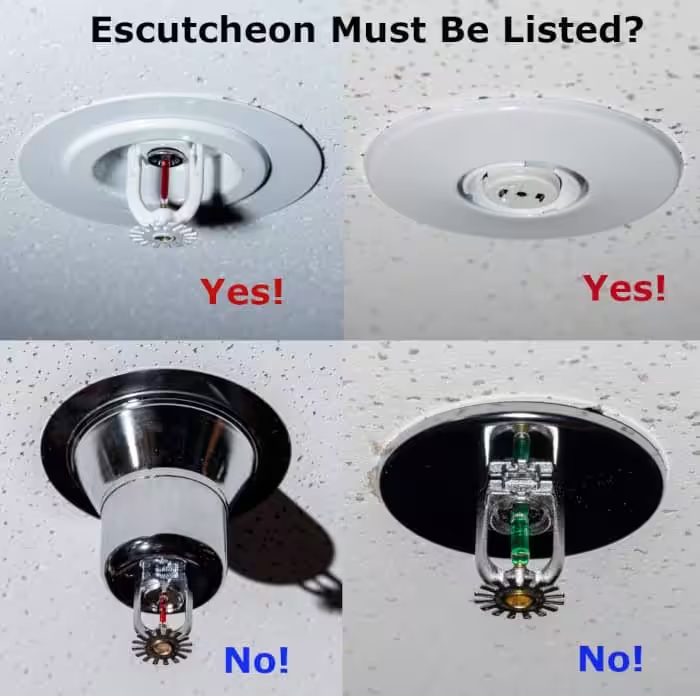
Previously, NFPA 25 only mandated replacing missing listed covers and escutcheons. However, section 5.2.1.1.5 of the 2026 edition now provides a list of conditions warranting replacement that are similar to those that apply to sprinklers:
(1) Physical damage
(2) Corrosion detrimental to sprinkler performance
(3) Loading [heavy dust, grime, etc.] detrimental to sprinkler performance
(4) Paint, other than that applied by the sprinkler manufacturer, detrimental to sprinkler performance
In addition, the new section 5.2.1.1.5.1 specifies replacing listed escutcheons and covers that are “found to be adhered or attached to the ceiling or wall,” such as by paint. And section 5.2.1.1.5.2 adds language clarifying that if a listed escutcheon or cover is no longer manufactured and needs to be replaced, you must replace the entire sprinkler assembly. This means buying a new sprinkler and escutcheon or cover that match the performance characteristics of the old sprinkler and assembly.
New requirements for the spare sprinkler cabinet list
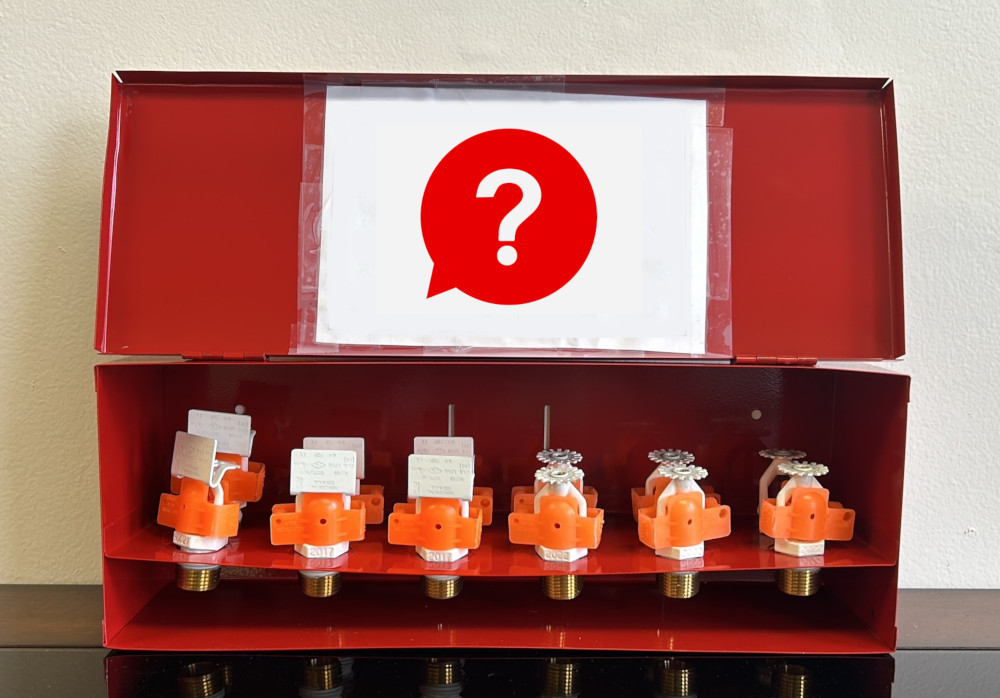
NFPA 25 has long required owners to maintain a supply of spare sprinklers and the manufacturer’s wrench(es) to install them in an onsite cabinet. Owners must keep at least two sprinklers of each type and temperature, plus a minimum number of spares based on system size—at least 6, 12, or 24, depending on total heads in the system.
In addition, the cabinet must have a list of the sprinklers in the cabinet, and this is where the changes come in. Section 5.4.1.6.6.1 of NFPA 25 2026 edition now adds the following items to this list (new items are emphasized):
(1) Sprinkler identification number (SIN), if equipped, the manufacturer, model, K-factor, deflector type, thermal sensitivity, pressure rating, and temperature rating
(2) Manufacturer’s sprinkler wrench model number for each sprinkler type
(3) General description
(4) Quantity of each type of sprinkler installed in the property
(5) Quantity of each type of sprinkler to be contained in the cabinet
(6) Issue or revision date of the list
These are commonsense additions that make it easier to replace sprinklers and maintain the system long-term. Replacing the word “orifice” with “K-factor” makes this sprinkler characteristic clearer and more precise for buyers. The standard also added “temperature rating,” another crucial performance characteristic that replacement sprinklers must match.
In addition, the quantity of each sprinkler installed on the property provides a very useful snapshot of the system that aids in both maintaining proper quantities of each spare sprinkler and comes in handy for sprinkler testing down the road. So, regardless of whether the 2026 edition of NFPA 25 is legally adopted in your jurisdiction (yet), updating the spare sprinkler cabinet list, where feasible, is a no-brainer.
New NFPA 2025 2026 edition impairment procedures impact system owners and managers
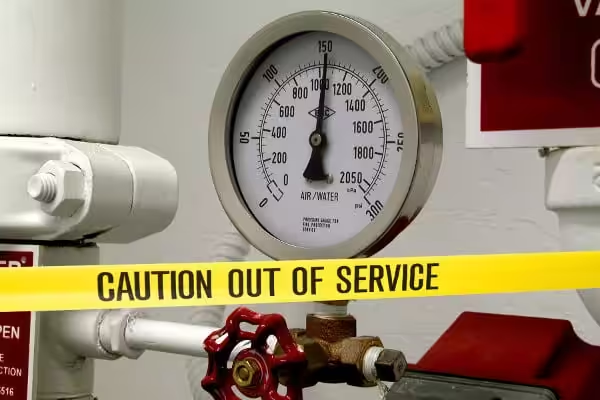
The NFPA 25 2026 edition clarifies impairment handling rules that building owners and managers must follow whenever water-based fire protection systems are taken out of service.
As in previous editions, property owners should notify their authority having jurisdiction (AHJ), the fire department, and the alarm service (as applicable). The notice must include the purpose of the shutdown or test, which part of the system is affected, and the expected duration (4.1.4.2). Two key 2026 clarifications strengthen this duty:
- Section 4.1.4.1 now makes clear that both preplanned and emergency impairments require the same notification procedures.
- Section 4.1.6.2 states that impairments (and deficiencies) must be corrected on a timeline approved by the AHJ. In addition, while any impairment remains uncorrected, owners must follow the full procedures in Chapter 15.
The new updates give owners clearer responsibility for timely notification and correction of impairments— and what qualifies as one.
Practical takeaways for building owners and managers
The changes to the NFPA 25 that most impact the tasks often done by system owners and their “designated representatives” (including facility managers) are not too extensive. Particularly relevant is focusing on the visual condition of sprinklers and assemblies (covers and escutcheons), the spare sprinkler cabinet inventory and list, and being aware of new impairment conditions. Otherwise, non-fire protection professionals should become qualified to complete basic inspection and maintenance tasks, as necessary, and complete the routine items that fall outside of a regular service call by a pro.
You can confirm with your local AHJ what “qualified for the specific task” means in your jurisdiction and whether onsite staff can perform these items. It’s also important to document everything for compliance and to avoid liability—and to escalate anything beyond basic work to a qualified ITM professional.
Keep your system compliant with the right replacement parts. Explore QRFS’s selection of fire sprinklers, cover plates, escutcheons, wrenches, spare-head cabinets, and other fire protection equipment.
If you have questions or need help finding an item, contact our customer service team.
This blog was originally posted at blog.qrfs.com.
