The problem
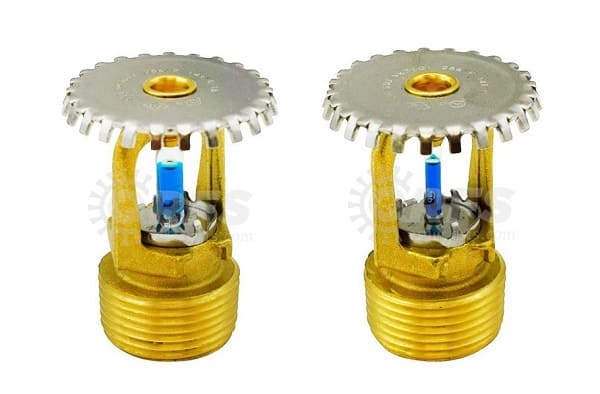
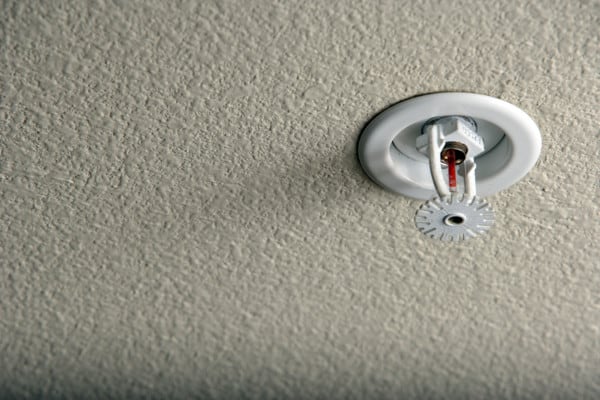
You’ve got a home fire sprinkler system with a damaged, activated, or otherwise deficient sprinkler, and you need a replacement. But there’s a bewildering selection of models and manufacturers, and your old sprinklers may no longer even be sold. Even worse, your sprinkler may have a crucial performance spec—its K-factor—that’s not present in any residential sprinklers on the market. What do you buy? How do you choose?
Why this matters
Fire sprinklers and systems have specific design characteristics that ensure they can control a fire. This performance is especially important in modern homes, which burn faster and hotter than in the past because of combustible building materials and furnishings. Flashover, the simultaneous ignition of flammable surfaces in a space, can happen in as few as two minutes—and residential fire sprinklers are specifically designed to control a fire so that you and your family have time to get out.
Putting in the wrong sprinklers with the wrong design may mean the system can’t do its job in an emergency. That’s why National Fire Protection Association standards say that you must get replacment sprinklers with “the same performance characteristics as the original equipment” (NFPA 13D, 2025: 12.3.2).
The fix
1. The first step is to see if you can replace a sprinkler with the same model.
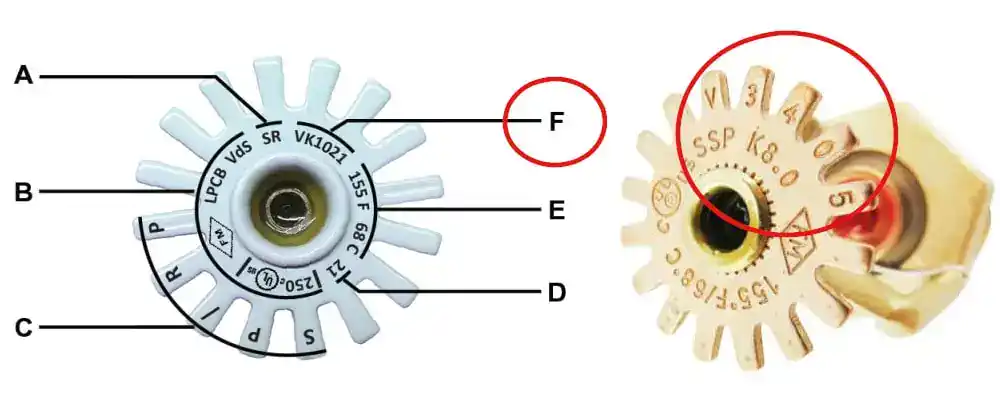
Look for a 4-to-7-digit sprinkler identification number (SIN) on the deflector that begins with the manufacturer letters R or RA, SS, TY, V, or VK. If you find that code, look to buy a sprinkler with the same SIN at the same activation temperature (also listed on the deflector).
If it isn’t possible to buy an exact replacement …
2. For sprinklers made before 2001 that don’t have a SIN—or with a SIN that’s no longer sold—you must ID the old model and replace it with a similar one.
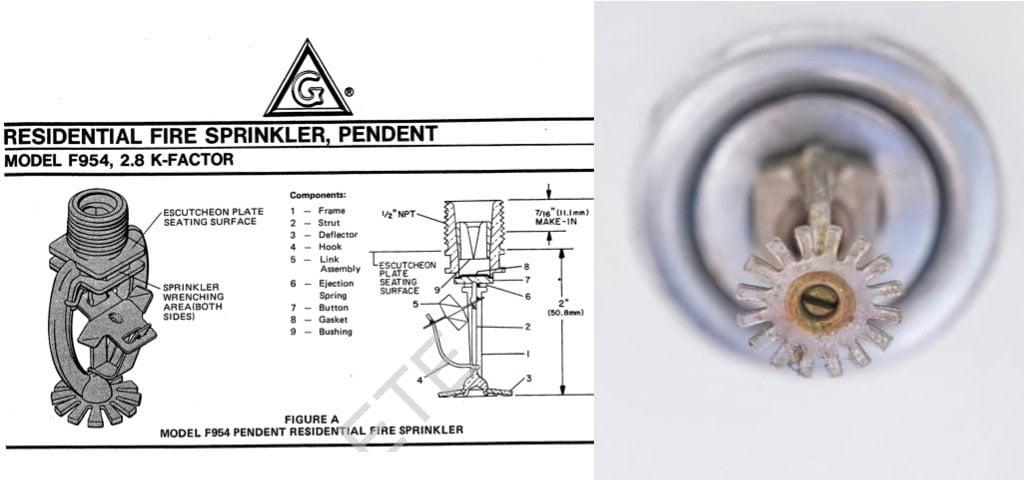
Identify the sprinkler by its SIN or other markings on the frame and deflector, then find its manufacturer’s data sheet online. This will tell you all the sprinkler’s key performance characteristics, which NFPA standards say a replacement sprinkler must have: the style, K-factor, spray pattern, temperature rating, and listed coating (if relevant). Need identification help? Contact QRFS!
3. For sprinklers with obsolete K-factors that don’t have a modern match, NFPA provides a workaround.
Unfortunately, many older home sprinklers made before 2003 have unusual K-factors—numbers that specify how much water passes through a sprinkler at a given pressure—that aren’t made anymore. The latest NFPA standards provide an updated rule that makes replacing these sprinklers easier. Choose a replacement with:
- A K-factor within ±5%, or
- The next larger available K-factor (This is the latest option in the rule)
- Without exceeding the new sprinkler’s listed coverage area (NFPA 13D, 2025: 12.3.2.1)
An NFPA committee member told us how to accomplish that last part: A fire protection pro should measure the distance from the old sprinkler to the furthest wall and double that number to estimate the current sprinkler’s coverage area (e.g., 8 feet to the wall = 16 x 16 feet). Then, look at the table on every residential sprinkler’s data sheet that details “Maximum Coverage Area” to make sure that area isn’t exceeded in your space.
An example: An old 3.9K 155-degree pendent residential sprinkler could be replaced with a Viking 4.3K 155-degree pendent residential sprinkler, as long as the coverage area works.
These rules were updated in the 2025 and 2026 editions of several NFPA standards, and qualified fire protection professionals must always be involved in sprinkler replacement. So, discuss this approach with a local pro and the authority having jurisdiction (AHJ).
Popular products
FAQs
Why does the K-factor matter so much?
It helps determine the amount of water that flows through the sprinkler and how it sprays. The wrong K-factor can mess up the “design density”—how much water wets nearby surfaces—and lessen fire control and suppression effectiveness.
Can I replace my sprinkler with any similar-looking model from the same brand?
No! The replacement must match key performance characteristics, including style, K-factor, temperature rating, orientation, and coverage area. Note that temperature ratings are ranges that allow some flexibility in the specific activation temperature within those ranges (though you should usually be able to find an exact activation temp match), and K-factors have the flexibility mentioned earlier in this blog.
What if I can’t find the same sprinkler model?
Identify the old sprinkler by any markings on the frame and deflector for pre-2001 heads, or by its sprinkler identification number (SIN), then find its manufacturer’s data sheet. Learn the old sprinkler’s key characteristics and find an equivalent that meets NFPA requirements to match them, including allowable K-factor substitutions, if applicable. QRFS can help with identification!
Are older sprinklers with very low K-factors still replaceable?
Yes, but you’ll need to use an equivalent K-factor within ±5% or the next larger size, followed by making sure the new sprinkler’s coverage area is big enough for the space.