The problem
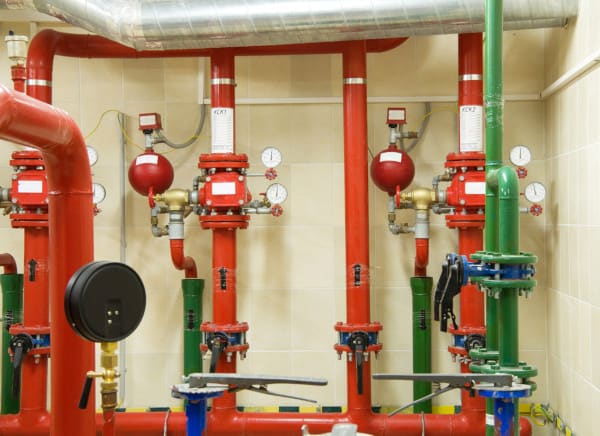
Angle valves are commonly used as main drain valves in fire sprinkler systems. They allow installers and maintenance personnel to drain water from system piping and perform main drain tests to assess the water supply.
But can you use just any angle valve for this purpose? Not necessarily. Although fire sprinkler main drains don’t require a specific valve design, the selected valve must meet requirements for size, pressure rating, connections, and approval.
Why this matters
Main drains allow water to be removed from sprinkler piping for maintenance and repairs, and they provide a means to conduct main drain tests. These tests flow water through the main drain while measuring static and residual pressures to help identify changes in the water supply, including possible obstructions or partially closed valves.
NFPA 13 does not require main drains to be listed or the use of angle valves specifically. Other options, including ball valves and combination test-and-drain valves, are also acceptable. Section 16.9.1.1 of NFPA 13 (2025) simply requires drain and test valves to be approved, meaning acceptable to the authority having jurisdiction (AHJ). However, some AHJs might require a listed valve, and some angle valves are UL Listed under standards such as UL 258, which evaluates valves intended for fire protection trim and drain applications.
That said, even an angle valve specifically marketed for fire protection may not be appropriate for every main drain application. Its specifications must match the system’s requirements.
The fix: How to choose an angle valve for a fire sprinkler main drain
1. Match the valve size to the required drain connection
Size is the most important consideration. Section 16.10.4.2 and Table 16.10.4.2 of NFPA 13 (2025) establish these minimum main drain connection sizes:
- Risers up to 2 inches: 3/4-inch drain connection or larger.
- Risers from 2-1/2 through 3-1/2 inches: 1 1/4-inch drain connection or larger.
- Risers 4 inches and larger: 2-inch drain connection or larger.
For example, consider two angle valves sold by QRFS:
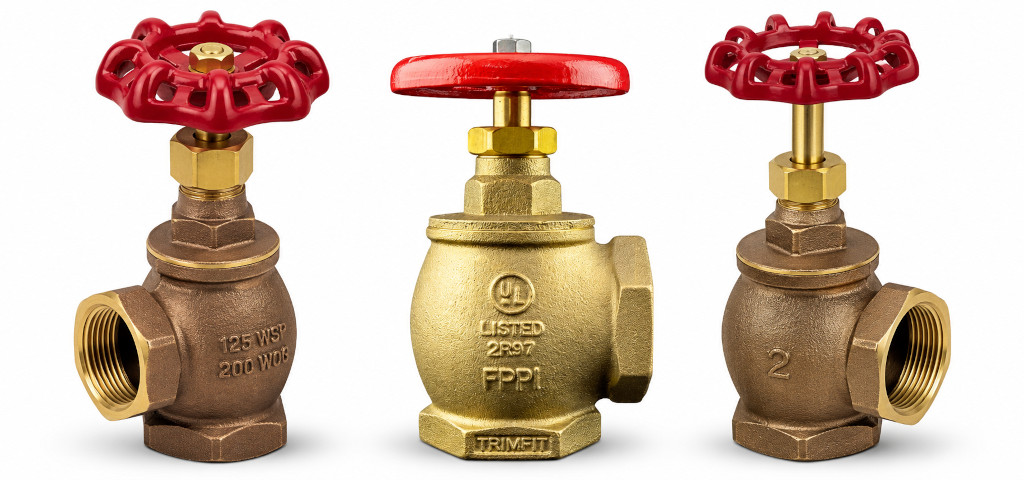
- The Lansdale 2-inch brass angle valve, rated for 200 psi working pressure, has 2-inch NPT connections and is marketed for fire sprinkler trim and drain applications. It is a suitable candidate for a main drain on a 4-inch sprinkler riser because it meets the nominal size requirement.
- The Lansdale 1/2-inch brass angle valve has the same working-pressure rating. However, its 1/2-inch connections are too small to satisfy the minimum main drain size requirements for the same riser—or even a smaller riser.
Both are fire protection angle valves, but they are not interchangeable for this application.
These are NFPA 13 minimums. Other requirements may be more restrictive. For example, in systems that must comply with FM, Section 2.3.7.1 of FM Property Loss Prevention Data Sheet 2-0 specifies a minimum 2-inch drain valve at the riser for each sprinkler system, regardless of riser size.
2. Check the valve’s pressure rating
Section 7.1.2 of NFPA 13 generally requires aboveground sprinkler components to have a working-pressure rating of at least 175 psi or the maximum system working pressure, whichever is greater. Section 16.9.1.2 also addresses using valves within their pressure ratings when water pressures exceed 175 psi.
All of QRFS’s standard angle valves for fire sprinkler trim and drain applications are rated for either 200 or 300 psi, making them suitable for conventional sprinkler systems operating within those pressure ratings.
Notably, a valve’s working-pressure rating is distinct from the temporary pressure it can withstand during hydrostatic testing. Valves are often designed and tested to withstand pressures substantially greater than their rated working pressures.
Thus, a 200-psi working-pressure rating does not automatically disqualify a valve from a system undergoing a 225-psi hydrostatic test, for example. A Lansdale technical representative explained that valves can generally withstand test pressures substantially higher than their rated working pressures and offered a conservative rule of thumb of 50% above the working-pressure rating for valves that are not UL Listed.
3. Verify the connections and valve design
Check that the angle valve connections match the piping. National Pipe Taper (NPT) threaded connections are standard on angle valves used for fire sprinkler trim and drain applications in the US and Canada, but other connection types and thread standards are used internationally.
In addition, note that not all “angle valves” are intended for the same purpose. Fire hose angle valves, for example, commonly have an NPT inlet and a different male hose-threaded outlet designed to connect to a fire hose. They should not be treated as direct replacements for standard NPT-connected drain valves just because their nominal sizes and pressure ratings are adequate.
4. Confirm that the valve is approved for the application
While NFPA 13 only says the AHJ must approve drain valves and does not require a listing, individual projects may impose stricter requirements. For example, the Orange County, Florida, Fire Station 48 specifications require trim and drain valves to be UL Listed or FM Approved.
If you need valves for fire sprinkler main drains, check out our selection of angle valves. We also carry ball valves and test-and-drain valves suitable for this application. Contact us if you have questions or need help finding the right part for your system!
Product recommendations
FAQs
Not generally under NFPA 13. Section 16.9.1.1 requires drain valves to be approved, rather than necessarily third-party listed. However, an AHJ, project specification, or insurer may impose additional requirements.
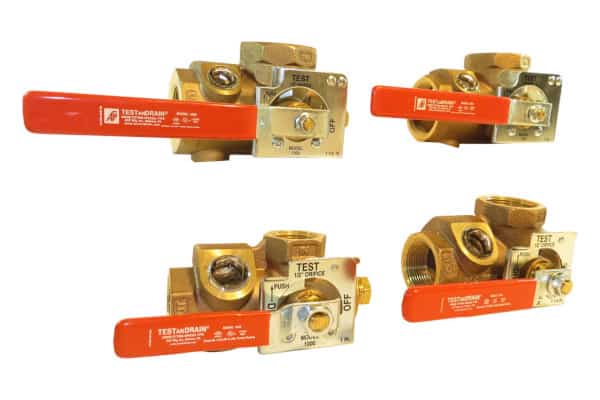
Yes. NFPA 13 does not prescribe a single valve design for main drains. An appropriately sized and rated ball valve—or a combination test-and-drain valve that simplifies installation by combining the inspector’s test and drain functions—may be used if the valve and installation meet applicable requirements and receive AHJ approval.
Yes. NFPA 13 does not generally require replacement drain valves to be from the same manufacturer. However, the replacement must meet applicable sizing, pressure-rating, connection, and approval requirements, as well as any additional project specifications.