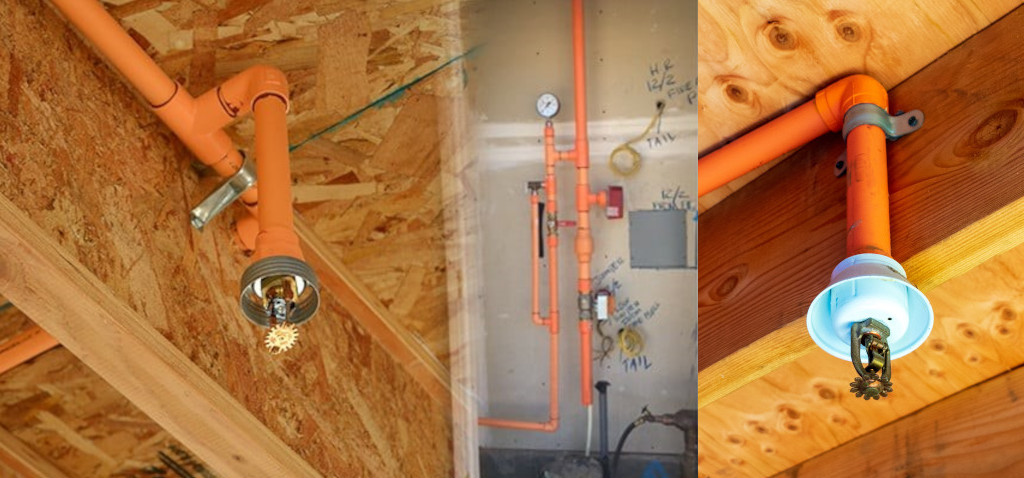
The problem
CPVC (chlorinated polyvinyl chloride) pipe expands and contracts roughly four to five times as much as steel pipe as temperatures change. This requires special consideration when installing pipe hangers, straps, and riser clamps. Supports must keep piping properly positioned without gripping it so tightly that it cannot move.
Consider a 15-foot vertical CPVC sprinkler pipe running up a wall. An installer may need to restrain the pipe against sideways movement while supporting its weight, so the vertical load does not rest entirely on a fitting at the bottom. But tightening a clamp around the pipe could interfere with thermal expansion and contraction. Installers must select appropriate supports and use them according to the CPVC manufacturer’s instructions.
Why this matters
Because CPVC expands more and is more susceptible to damage than metal, supports must avoid squeezing, cutting, or abrading the pipe and allow it to move a little. Tight supports may cause damage during or after installation, and restricted thermal movement can create stress at fittings and joints, potentially causing cracks or leaks.
How much movement are we talking about? The Viking BlazeMaster® thermal expansion table (similar to other manufacturers’ tables) shows how expansion increases in direct proportion to both pipe length and temperature change. For example, a 60°F temperature increase produces approximately:
- 0.37 inches of expansion in a 15-foot pipe.
- 2.20 inches of expansion in a 90-foot pipe.
Expansion and contraction rates are very similar among CPVC manufacturers, though the specific amount depends on the manufacturer’s specific thermal expansion coefficient. Even relatively short runs require properly installed supports, and allowing a pipe to slide through its hangers does not necessarily address all expansion stresses throughout the system.
The fix
1. Use CPVC-compatible hangers and straps that allow movement
Properly selected and installed CPVC hangers and straps support piping without gripping it excessively, allowing movement during thermal expansion and contraction. Many feature rounded or beveled edges to prevent abrasion, including as the pipe moves. Depending on their design and installation, listed CPVC straps can support horizontal piping or serve as guides or restraints.
Hangers not specifically designed for CPVC may also be suitable. For example, Spears FlameGuard® installation instructions permit certain conventional metal hangers if they provide at least a 1/2-inch load-bearing surface, fit the pipe’s size, and have no rough or sharp edges contacting the pipe. They must also not restrict axial movement and must meet applicable listing, installation, and support-spacing requirements.
2. Support vertical CPVC risers without squeezing the pipe
Vertical CPVC risers present a similar challenge: Their supports must carry the pipe’s weight without relying on compression. One manufacturer-approved method is to position a riser clamp directly beneath the shoulder of a fitting or under an added support collar made from a modified CPVC coupling solvent-cemented around the pipe. The fitting or collar rests on the clamp, transferring the vertical load to the support structure without squeezing the pipe. Manufacturer instructions illustrate both arrangements and explain how to prepare and attach a modified coupling. Note that a collar serves only as a support, not as a fitting for joining pipe sections.
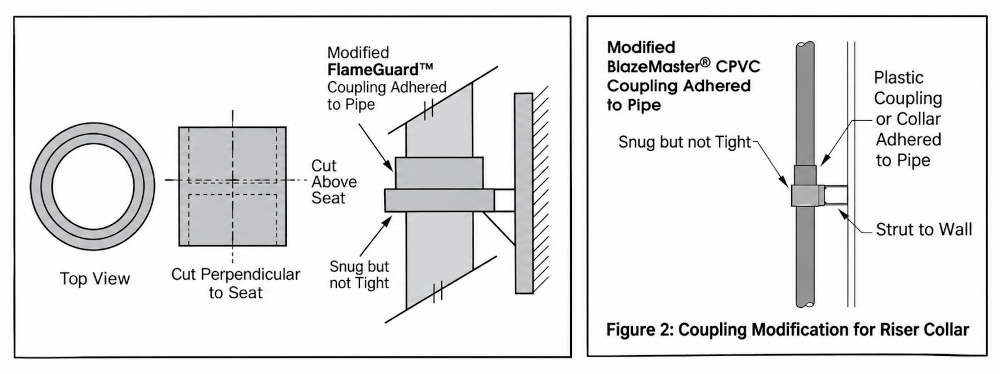
Another permitted method involves placing listed hangers on the horizontal piping connected to the riser, near the point where the pipe changes direction. These hangers must be positioned to provide adequate support without imposing excessive stress on the elbow or other fittings. Follow the manufacturer’s installation requirements for the particular arrangement.
Both Spears FlameGuard and Viking BlazeMaster require vertical piping to remain straight and be supported at each floor level or at 10-foot intervals, whichever is less.
3. Account for expansion throughout the piping system
Proper hangers and riser clamps are only part of the solution. The system’s piping layout must also accommodate thermal movement.
Changes in direction, particularly those using 90-degree elbows, can often provide the flexibility needed for expansion and contraction. Longer straight runs or installations with substantial temperature variations may require expansion loops or offsets. These arrangements incorporate elbows and lengths of piping that flex to accommodate movement.
The correct approach depends on pipe length, diameter, expected temperature changes, and system configuration. Manufacturer installation instructions, including those from Spears FlameGuard and Viking BlazeMaster, explain how to calculate expected movement and design appropriate expansion loops and offsets.
When you need parts, check out QRFS’s selection of CPVC pipe, fittings, plugs and cement, including from both Viking BlazeMaster and Spears FlameGuard. We also carry CPVC hangers, plus riser clamps that can work with your installation. Questions or need help finding a part? Contact us!
Top image sources: Home Fire Sprinkler Coalition via US DOE, Shutterstock
Product recommendations
FAQs
A manufacturer-approved arrangement positions the clamp beneath the shoulder of a fitting or CPVC support collar attached around the pipe. The fitting or collar bears the vertical load without requiring the clamp to squeeze the pipe.
Spears FlameGuard and Viking BlazeMaster specify support at each floor level or at 10-foot intervals, whichever is less. Consult the applicable manufacturer’s instructions.
No. Changes in piping direction can often accommodate expansion and contraction. Longer straight runs or substantial temperature variations may require loops or offsets, as determined by the manufacturer’s design guidance.
Hangers and restraints must perform their intended support functions without improperly restricting thermal expansion and contraction. Never overtighten a hanger or use a riser clamp that relies on squeezing the pipe to support its weight.