The problem
Mechanical tees are familiar components in fire sprinkler systems, but buying and installing some of them might have become a bit more confusing. Various manufacturers have changed the specified hole sizes for certain mechanical tees following updates to UL 213: Rubber Gasketed Fittings for Fire-Protection Service. In addition, GemLock also replaced several of their “Style” model numbers with new ones.
These changes are important when replacing an old fitting, ordering from memory, or reaching for the same hole saw used in the past. Assuming that a replacement fitting uses the same opening as an older product can lead to incorrect pipe cuts.
Why this matters
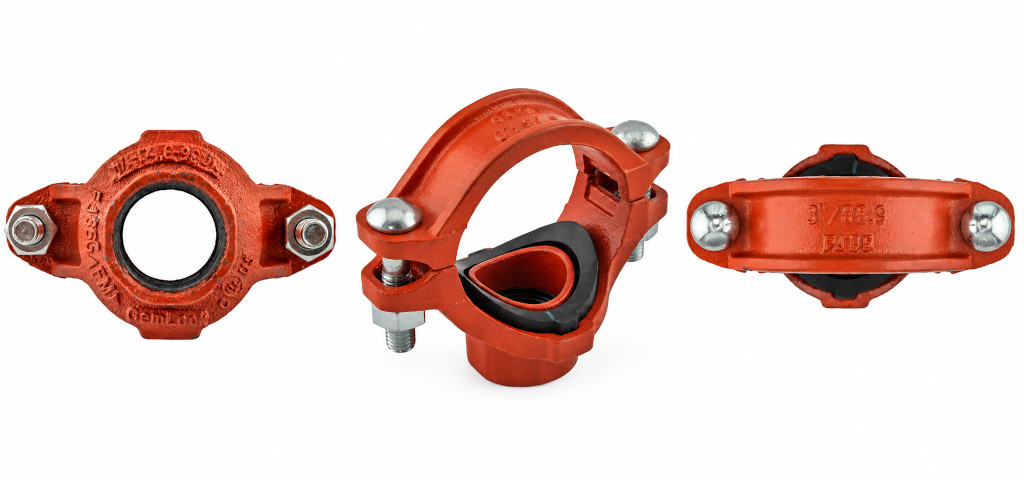
A mechanical tee clamps around an existing pipe run to create a side outlet for a branch line or other downstream piping. The installer cuts an opening in the run pipe, and the fitting seals over it to let water flow through the outlet. The required opening is specified for the particular listed fitting based on its run and outlet sizes. For example, a 4 x 2-1/2 in. mechanical tee fits a 4-in. run pipe, provides a 2-1/2-in. outlet, and may require a 2-3/4-in. opening in the run pipe.
The underlying issue involves UL 213. UL revised requirements affecting side-outlet fittings such as mechanical tees. Among other things, the standard addresses the construction of the portion of the fitting that enters the pipe opening and evaluates the hydraulic performance of side outlets.
Importantly, UL evaluates these fittings as installed according to the manufacturer’s instructions. That means the opening cut in the run pipe is part of the tested installation.
As manufacturers updated or requalified fittings under the revised UL requirements, some specified pipe-hole dimensions changed. The revisions have also helped standardize hole dimensions for comparable fittings among manufacturers.
However, dimensional changes vary, and they aren’t the only updates manufacturers can make. In GemLock’s case, it replaced its Style 13 line with Style 13A, Style 15 with Style 35, and Style 16 with Style 36. Some nominal configurations received different hole specifications, while others retained the same hole dimensions despite a new Style designation.
The fix
Don’t select or install a mechanical tee based only on an old product designation or a remembered hole-saw size. Before ordering or drilling, verify the exact fitting’s run size, outlet size, outlet type, current product designation, required hole size, and maximum permissible opening against the manufacturer’s current data sheet.
GemLock states that existing installations and direct replacements are fine—in the limited period in which those old models are still available. However, updating to a new part that has a new hole specification will require updating the hole size.
GemLock provides a useful example of how these changes can vary, though other manufacturers have also revised some numbers. The table below compares some representative configurations from the latest data sheets for previous-generation Styles with the current replacement products:
| Product change | Configuration covered | 2023 old-style hole spec | Current new-style hole spec | What changed |
| Style 13 → Style 13A Tee Lock | All listed configurations | Hole saw: 1-3/16 in. | Hole diameter: 1-5/16 in. min.; 1-3/8 in. max. | Opening increased |
| Style 15 → Style 35 grooved mech tee | 4 x 2-1/2 in. | Hole saw: 3-1/4 in.; max: 3.35 in. | Hole saw: 2-3/4 in.; max: 2.88 in. | Opening decreased |
| Style 15 → Style 35 grooved mech tee | 6 x 2-1/2 in. | Hole saw: 3-1/4 in.; max: 3.35 in. | Hole saw: 2-3/4 in.; max: 2.87 in. | Opening decreased |
| Style 16 → Style 36 threaded mech tee | 4 x 2-1/2 in. | Hole saw: 3-1/4 in.; max: 3.35 in. | Hole saw: 2-3/4 in.; max: 2.87 in. | Opening decreased |
| Style 15 → Style 35 grooved mech tee | 4 x 2 in. | Hole saw: 2-1/2 in.; max: 2.63 in. | Hole saw: 2-1/2 in.; max: 2.63 in. | No hole-spec change |
Note: This table is not a complete list of every GemLock mech tee SKU. Check the current data sheet for a specific part.
So, the solution is fairly simple: always use the current manufacturer specifications for the specific fitting being installed.
If an existing hole is too small for a replacement fitting, it may be possible to enlarge it to the specified size using appropriate hole-cutting equipment. However, the finished opening must meet the replacement fitting’s size, location, and surface-preparation requirements. If the hole exceeds the fitting’s maximum permissible diameter, installers should replace the affected pipe section or use another listed, manufacturer-approved solution.
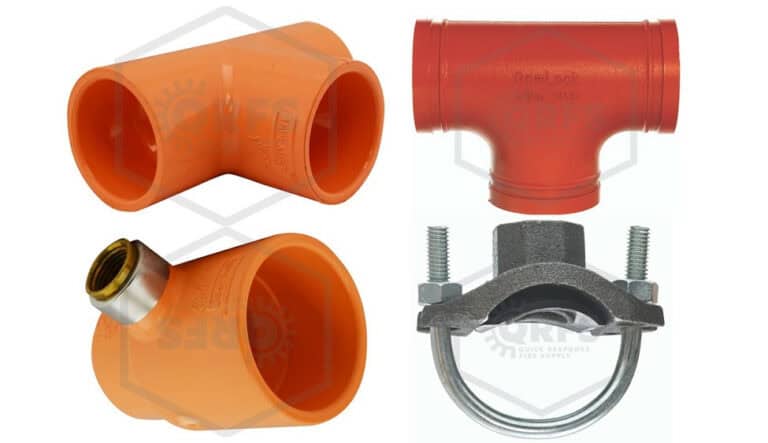
If you need parts, check out QRFS’s selection of mechanical tees, plus other pipes and fittings and cutting and installation tools. If you have questions, contact us!
Product recommendations
FAQs
No. The changes discussed here involve UL 213, the product standard used to evaluate and list these fittings.
No. Hole requirements changed for some configurations but remained the same for others. Always check the current data sheet rather than assuming the old dimensions still apply.
Only if the current manufacturer instructions specify that size. Don’t assume an old fitting and its replacement require the same opening.
No. Existing, properly installed mechanical tees can remain in service. However, as older models such as GemLock Styles 15 and 16 are phased out, replacements may require newer models, such as Styles 35 and 36. If the replacement fitting specifies a different hole size, the existing pipe opening must be modified as necessary to meet the new requirements.