


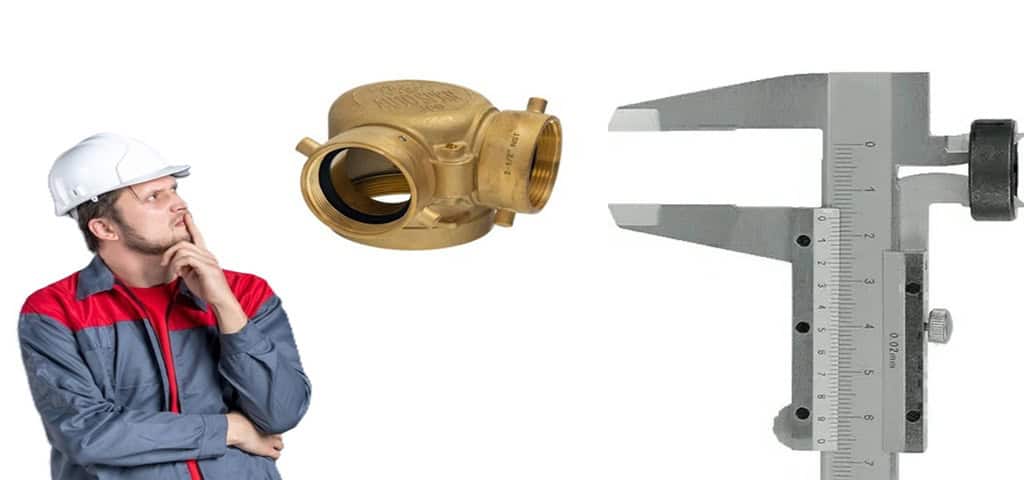
National Hose is the normal fire hose thread—but it’s not universal
Threaded fire hose connections allow firefighters to access water and supply it to systems to fight fires. A hose connects the fire hydrant to the pump engine, which sends high-pressure water through attack hoses or hoses connected to a building’s fire department connection (FDC). An FDC lets firefighters pump water into a standpipe or sprinkler system to augment or completely supply a fire protection system with water, supporting or enabling firefighting efforts. If you’re a building owner or manager, it’s on you to maintain your FDCs. Unfortunately, FDC threads and sizes are not universal across jurisdictions.
While the National Fire Protection Association (NFPA) defines a standard for fire hose threads called National Hose, many jurisdictions don’t use it. Even (and perhaps especially) large jurisdictions like New York City and Chicago have their own local thread standards. If you need to install or replace FDCs or just components like swivels or plugs, you should check with your authority having jurisdiction to verify which size and type of threads to use.
This article aims to help you understand why and where thread standards are different, including:
- The history of fire hose threads, including disasters that were exacerbated by their mismatch
- Some major fire hose thread standards
- A list of major US cities and the hose thread standards and sizes they use
QRFS has FDC bodies, caps and plugs, snoots and swivels, and signage in stock. To order thread styles other than NH/NST and FDNY (or for help finding out what thread standard you need), contact our customer service team!
A brief history of fire hose and equipment couplings
Fire hydrants and hoses, along with trouble connecting them, are older than you might think. Dutch inventor Jan van der Hyden made what may be the first fire hoses—hand-sewn leather tubes—in the 1670s. Subsequent improvements to the fire hose included a durable rubber lining.
But the fire hose, as we know it, is often nothing without the fire hydrant, which has evolved alongside the water mains it accesses. When early water mains were made of wood, firefighters dug down to the pipes and drilled into them wherever they could, and then plugged up the holes for later use. Something resembling the cast-iron above-ground hydrants we know today emerged around 1801, the invention typically credited to Frederick Graff Sr., Chief Engineer of the Philadelphia Water Works.
In these early days of fire hoses and hydrants, the couplings were not standardized. Fire departments sourced their hydrants and hose couplings from local foundries and blacksmiths, who each cut the threads according to their personal method. While it sounds chaotic, this piecemeal method mostly worked. As long as fire services stuck with the same suppliers and thread standards, they would always be able to connect to their own fire hydrants.
But trouble happens when firefighters work outside their jurisdictions through mutual aid, when a fire service has a fire or a group of fires so large that they call for outside help. Some of America’s biggest fire disasters have been exacerbated by the resulting thread mismatches. If neighboring fire services can’t connect their hoses to local hydrants, they can’t bring their pumps to bear on a fire.
The Great Boston Fire of 1872 is a major example of this issue. The fire destroyed much of downtown Boston and killed 14 people. Firefighting crews responded from all over New England (remember, this was the age of the horse-drawn fire engine). However, water supplies ran short, the narrowness of streets made it hard to maneuver the engines, and, of course, non-standardized hydrant and hose threads prevented outside fire crews from using local hydrants.
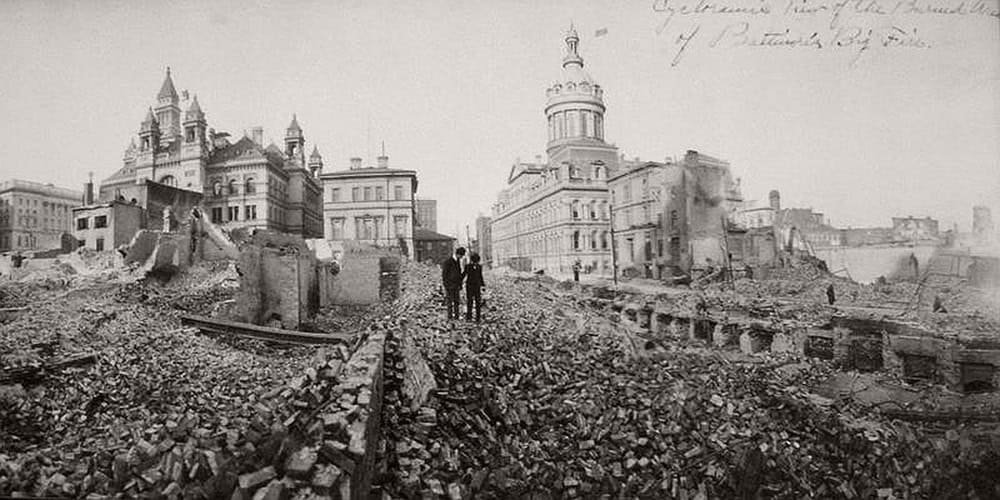
The Baltimore Fire of 1904 also destroyed over 1,500 buildings and burned for two days. More than 1,200 firefighters fought the blaze, and many were injured, including firefighters from surrounding Maryland towns and some from out of state who arrived by rail. Like in the Great Boston Fire, mutual aid efforts were hampered by incompatible fire hoses and hydrants.
It was actually this disaster in Baltimore that spurred the National Fire Protection Association (NFPA) to begin standardizing fire hose thread sizes. This effort eventually led to the publication of NFPA 1963, which is now a chapter within NPFA 1960: Standard for Fire Hose Connections, Spray Nozzles, Manufacturer’s Design of Fire Department Ground Ladders, Fire Hose, and Powered Rescue Tools (2024 edition). NFPA 1963 established the National Hose (NH) thread standard for fire hoses, fire hydrants, and fire department connections. Now, a standard fire hydrant has 2-1/2” and 4” male NH threads that fit the corresponding NH-threaded hoses. Likewise, a standard FDC has two (“Siamese”) 2-1/2” NH female inlets.
So, problem solved! No more fire disasters have ever happened in the United States because of mismatched fire hose threads, right? Not true. In 1991, a fire that came to be known as the Oakland Firestorm killed 25 people and burned 1,520 acres, including 2,843 homes and 437 apartments or condos. Mutual aid came from across the Oregon state line from Nevada and from as far south as Bakersfield, but crews had challenges connecting to Oakland’s fire hydrants.
Oakland has since adopted the NH standard, but over 100 years after the Baltimore Fire of 1904, many jurisdictions still do not use the National Hose standard. These holdouts still exist because changing thread standards means replacing all threaded connections, including hydrants and FDCs, at great expense. Also, some departments—for example, the Fire Department of New York—are so large that they, and other jurisdictions around them, adopt their standards. Also, it’s common for engines to carry hose adaptors for hooking up to differently threaded outlets, partially solving the problem.
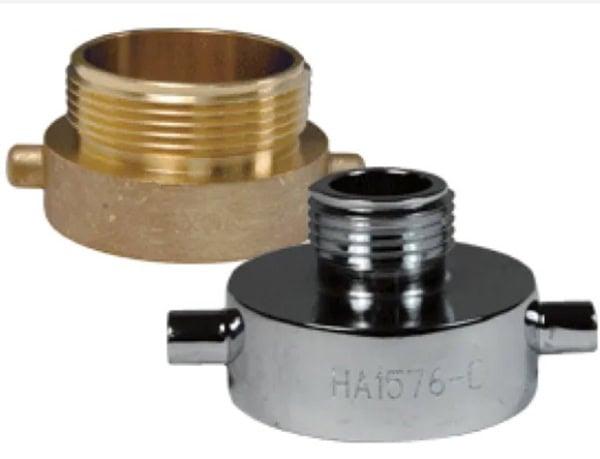
Major fire hose and FDC thread standards
As mentioned above, NFPA established National Hose (NH) as the fire hose thread standard for the US when it first published NFPA 1963. However, NFPA standards give local authorities having jurisdiction (AHJs) the discretion to establish alternative thread standards. For example, NFPA 14: Standard for the Installation of Standpipe and Hose Systems (2024 edition)says:
7.9.4.1 Where local fire department hose threads do not conform to NFPA 1963, the AHJ shall designate the hose threads that shall be used for the fire department connection.
Indeed, many jurisdictions do use standards other than NH/NST. Below, we’ll look at some of the most significant hose thread standards in the United States.
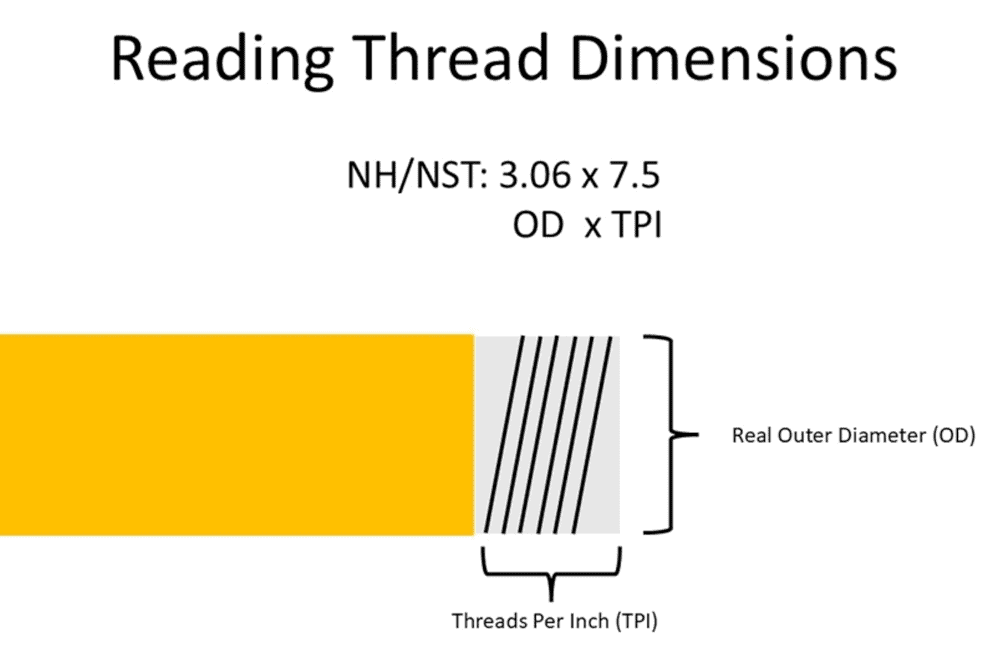
To understand a thread’s dimensions, you need to understand the notation for threads per inch (TPI) and the actual outer diameter (OD) of the male thread. Thread sizes are named with nominal sizes, but these don’t match their actual size. For example, FDC inlets are typically 2-1/2” NH female connections, but neither NH nor any other thread standard actually has a male outer diameter measuring 2-1/2”—it’s far closer to 3” actual size. Don’t get confused—some California jurisdictions use 3” nominal hose connections where most others use 2-1/2” nominal. This is why measuring FDC parts for replacement caps and plugs correctly depends on measuring the diameter of the inner waterway, not the outer diameter.
Threads per inch is an important metric. It’s the number of peaks you would find on 1” of thread cut into a pipe or fitting. Even if two thread standards match or are close enough by outer diameter, a difference in TPI can make them incompatible (and damage both if you try to connect them).
Let’s take a look at some of the major thread standards currently in use in the United States, including:
- National Hose Thread
- Iron Pipe Thread
- FDNY Thread
- New York Corporation Thread
- Chicago Fire Department Thread
Because QRFS is focused on FDC threads here, we’ll only cover the 2-1/2” nominal size for each standard.
National Hose/National Standard Thread
National Hose (NH), also called National Standard Thread (NST), is the standard, default thread for fire hoses, fire hydrants, and FDCs that was established in NFPA 1963. Most jurisdictions in the United States use NH threads.
A 2-1/2” nominal NH FDC connection has a real outer diameter of 3.0686” and 7.5 threads per inch.
Iron Pipe Thread/National Pipe Straight Hose
Iron Pipe Thread (IPT) is one of the main “competitors” to NH thread. Also called National Pipe Straight Hose (NPSH), this standard is very similar to National Pipe Thread, or NPT—a tapered thread standard used for joining pipes. IPT uses the same outer diameter and threads-per-inch values as NPT, but with a straight thread, which means that a female IPT coupling can thread onto a male NPT coupling. The standard for NPSH/IPT is established in the American National Standards Institute’s ANSI-ASME B1.20.7 standard.
A 2-1/2” nominal NPSH FDC connection has a real outer diameter of 2.841” and 8 threads per inch.
New York Fire Department Thread
New York City’s fire department uses its own fire hose thread standard—FDNY Thread. Some other cities in the New York/New Jersey area also use this standard. Baton Rouge, LA, also used FDNY thread.
FDNY Thread has an outer diameter of 3.030” and 8 threads per inch.
New York Corporation Thread
New York Corporation (or New York Corp) thread is a thread used in New York and New Jersey, but not in New York City itself. It’s also found farther afield. For example, New York Corp thread is used in Toledo, OH.
The dimensions for New York Corp. thread are 3” outer diameter x 8 threads per inch.
Chicago Fire Department Thread
Chicago Fire Department (CFD) thread is used in the city of Chicago. These 2.5” nominal CFD threads have an outer diameter of 3” and 7.5 threads per inch.
A list of FDC thread standards in major American cities
We provide a working table of known thread standards for major cities below—but note that determining which standard a given jurisdiction uses is not always straightforward. So, there are some caveats and context to the list.
For example, section 912.3.1 of the Code of the City of New Orleans, Louisiana, specifies that the city is on the NH/NST standard for its 2-1/2” hose connections (which would include FDC inlets). However, it also says that this jurisdiction’s smaller 1-1/2” hose connections are on the IPT standard. Because our focus here is on FDC threads, we report “NH/NST” for New Orleans in the table below.
Another complex example is San Francisco, CA. San Fran FDC threads are on the NH/NST standard—but they are 3” nominal instead of the normal 2-1/2” nominal. In fact, the fire hydrants in San Francisco also use 3” outlets instead of 2-1/2”, a fact that has raised concerns. Some other California cities also do this, and we’ll note them in the table below.
Local fire codes and regulations are also somewhat of a moving target. For example, Denver, Colorado’s fire code had a non-standard thread in 2022 (only for its smaller 1-1/2” hoses), but has since moved away from that to exclusively use the national standard.
All this is to say that, while QRFS has diligently researched the information below using reputable sources, the definitive source is your local AHJ. Check with them to confirm the correct thread standard for your fire department connections.
Here’s a list of standards in major American cities:
| City | FDC Thread Standard/Size |
|---|---|
| Akron, OH | 3.25″ OD x 6 TPI |
| Albuquerque, NM | NH/NST (3.0686” OD x 7.5 TPI) |
| Atlanta, GA | NH/NST (3.0686” OD x 7.5 TPI) |
| Austin, TX | NH/NST (3.0686” OD x 7.5 TPI) |
| Baltimore, MD | NH/NST (3.0686” OD x 7.5 TPI) |
| Baton Rouge, LA | NY Corp. (3″ OD x 8 TPI) |
| Charlotte, NC | NH/NST (3.0686” OD x 7.5 TPI) |
| Charlottesville, VA | 3.281″ OD x 8 TPI |
| Colorado Springs, CO | NH/NST (3.0686” OD x 7.5 TPI) |
| Dallas, TX | NH/NST (3.0686” OD x 7.5 TPI) |
| Dayton, OH | 3.234″ OD x 6 TPI |
| Detroit, MI | 3.125″ x 7.5 TPI |
| El Paso, TX | NH/NST (3.0686” OD x 7.5 TPI) |
| Erie, PA | 3.078″ OD x 8 TPI |
| Fort Worth, TX | NH/NST (3.0686” OD x 7.5 TPI) |
| Houston, TX | NH/NST (3.0686” OD x 7.5 TPI) |
| Indianapolis, IN | NH/NST (3.0686” OD x 7.5 TPI) |
| Jacksonville, FL | NH/NST (3.0686” OD x 7.5 TPI) |
| Kansas City, MO | NH/NST (3.0686” OD x 7.5 TPI) |
| Lafayette, LA | 3.078″ OD x 8 TPI |
| Las Vegas, NV | NH/NST (3.0686” OD x 7.5 TPI) |
| Los Angeles, CA | NH/NST (3.0686” OD x 7.5 TPI) |
| Louisville, KY | 3.125″ OD x 6 TPI |
| Memphis, TN | NH/NST (3.0686” OD x 7.5 TPI) |
| Mesa, AZ | NH/NST (3.0686” OD x 7.5 TPI) |
| Miami, FL | NH/NST (3.0686” OD x 7.5 TPI) |
| Milwaukee, WI | NH/NST (3.0686” OD x 7.5 TPI) |
| Minneapolis, MN | NH/NST (3.0686” OD x 7.5 TPI) |
| Nashville, TN | NH/NST (3.0686” OD x 7.5 TPI) |
| Raleigh, NC | 3.34″ OD x 6 TPI |
| Reading, PA | 3.23″ OD x 6 TPI |
| Richmond, VA | 3.312″ OD x 8 TPI |
| Sacramento, CA | NH/NST (3.0686” OD x 7.5 TPI) |
| San Antonio, TX | NH/NST (3.0686” OD x 7.5 TPI) |
| San Diego, CA | NH/NST (3.0686” OD x 7.5 TPI) |
| San Francisco, CA | NH/NST (But larger: 3″ nominal instead of 2.5″ nominal) |
| San Jose, CA | NH/NST (But larger: 3″ nominal instead of 2.5″ nominal) |
| Santa Ana, CA | NH/NST (3.0686” OD x 7.5 TPI) |
| St. Louis, MO | NH/NST (3.0686” OD x 7.5 TPI) |
| Toledo, OH | NY Corp. (3″ OD x 8 TPI) |
| Tulsa, OK | NH/NST (3.0686” OD x 7.5 TPI) |
| Tuscan, AZ | NH/NST (3.0686” OD x 7.5 TPI) |
| Virginia Beach, VA | NH/NST (3.0686” OD x 7.5 TPI) |
| Washington, DC | NH/NST (3.0686” OD x 7.5 TPI) |
| Wichita, KS | NH/NST (3.0686” OD x 7.5 TPI) |
| Yonkers, NY | NY Corp. (3″ OD x 8 TPI) |
Make sure your FDC threads match local fire hoses!
Standardization makes many things far more efficient and effective. That’s doubly true in fire protection, where the reliable fit and function of equipment can mean life or death. That’s why most fire hoses (and therefore fire hydrants and FDCs) use the National Hose (aka National Standard Thread) standard for thread dimensions. But many cities still use their own alternative standards! To stay compliant, make sure your FDC threads match the hoses used by the local fire department.
QRFS stocks FDC parts in NH and FDNY thread standards, and we can order inlets for many other standards. Check out our selection, or contact our customer service team with questions or for help with special orders.
This blog was originally posted at blog.qrfs.com.
