


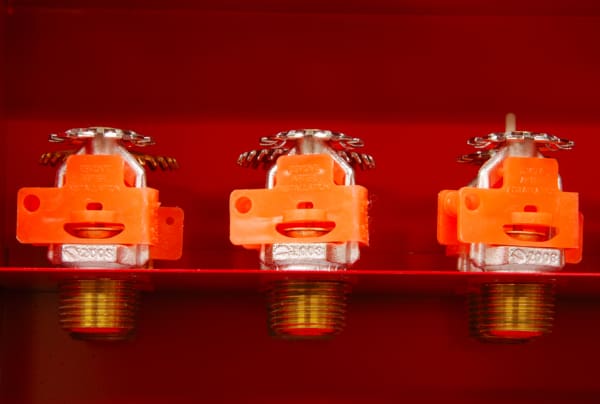
A spare sprinkler storage cabinet with the right number and type of heads keeps systems compliant — and working
Every NFPA 13- and NFPA 25-compliant fire sprinkler system requires a stock of spare fire sprinkler heads. Yet understocked fire sprinkler head cabinets are one of the most common fire protection violations spotted by inspectors.
In this article, we explain what you need in a fire sprinkler cabinet and where to keep it. We’ll cover the number and types of spare sprinkler heads required, plus wrenches, and go over common labeling and listing requirements.
Already know what you need? Feel free to skip directly to our selection of replacement fire sprinkler heads, wrenches, and fire sprinkler head cabinets.
The number of spare fire sprinklers required varies with the system’s size
At a minimum, a fire sprinkler head replacement cabinet should contain six spare fire sprinkler heads and a fire sprinkler wrench (or wrenches) suitable to the type of sprinklers in use. However, that number goes up based on the size of the system.
Most jurisdictions have adopted codes that reference standards from the National Fire Protection Association (NFPA). NFPA 13: Standard for the Installation of Sprinkler Systems stipulates that each fire sprinkler system requires a stock of at least six spare sprinklers (with the exception of dry fire sprinklers, which we’ll explain in the next section).
From the 2025 edition of NFPA 13
16.2.7.1* A supply of at least six spare sprinklers shall be maintained on the premises so that any sprinklers that have operated or been damaged in any way can be promptly replaced.
Explanatory material: Spare sprinklers of all the types and ratings installed must be available. For a building with a variety of sprinklers, the number of spare sprinklers should be increased above the minimum.
In a later section (16.2.7.5), NFPA 13 states that the stock of spare sprinklers “shall include all types, orientations, and [temperature] ratings installed” and varies with the size of the fire sprinkler system. The table below details these requirements.
| Total Number of Sprinklers Installed | Spare Heads Required |
|---|---|
| Under 300 | No fewer than 6 |
| 300-1000 | No fewer than 12 |
| Over 1000 | No fewer than 24 |
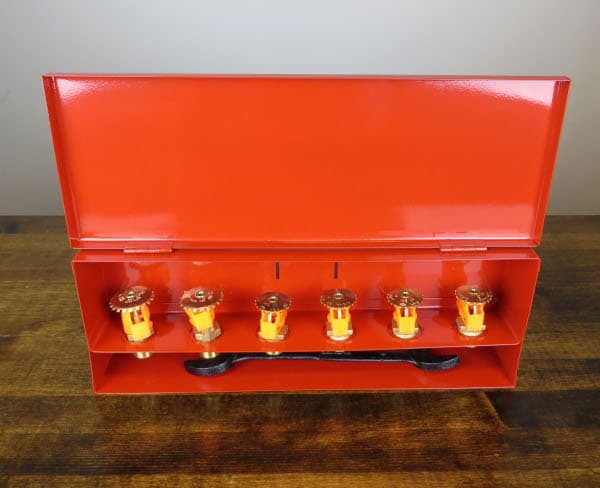
Exact spares are not required onsite for some dry sprinklers, but a means of restoring the system after activation is required
NFPA carves out a big exception for fire sprinkler cabinets: some dry sprinklers.
Dry-type, aka dry-barrel sprinklers are specially designed and installed for use in areas exposed to low temperatures. Used in outdoor loading docks, freezers, and other locations, these sprinklers feature a barrel that extends from the sprinkler to the pipe arrangement and remains dry until the sprinkler activates and releases a seal at the inlet, allowing water to enter the barrel and discharge.
Manufacturers provide dry sprinklers with barrels of different lengths. The lengths vary with the specific application and installation measurements, as well as expected ambient temperatures when a sprinkler passes from a warm to cold space: as temperatures grow colder, the minimum length of the barrel grows longer. You can read more about these requirements here.
Because dry pipe sprinklers’ lengths can vary even in a single sprinkler system, NFPA 13 requires cabinets for dry sprinklers only if they are all the same length.
From the 2025 edition of NFPA 13
16.2.7.4 Where dry sprinklers of different lengths are installed, spare dry sprinklers shall not be required, provided that a means of returning the system to service is furnished.
NFPA 13’s explanatory text sheds some light on what constitutes a means of returning the system service:
In systems where dry-type sprinklers of various lengths are installed, spare dry sprinklers are not required if the system can be temporarily placed back in service after a sprinkler activation. Such temporary service can be accomplished by the installation of non-dry-type sprinklers in areas that are temporarily not subjected to freezing temperatures or through the use of plugs in areas that will remain below freezing.
It also advises that owners of “some critical facilities” may keep a stock of their longest sprinklers on hand “until dry sprinklers of the correct length can be obtained and installed.”
All replacement sprinkler heads should be stored in a properly placed cabinet
As cited earlier, NFPA 13 section 16.2.7.1 requires that sprinklers remain in a cabinet and that that cabinet stays onsite. That’s because while some facilities employ on-call sprinkler contractors, there is no guarantee that these contractors will have the specific replacement sprinklers your facility requires. Place these cabinets in an accessible location. One good practice involves storing spare keys in a fire department lockbox or in a location where 24-hour staff—security guards, front desk attendants, and so on—can get to them.
Proper placement also involves keeping the cabinet out of places where heat might inadvertently activate the heads.
From the 2025 edition of NFPA 13
16.2.7.3 The sprinklers shall be kept in a cabinet located where the temperature to which they are subjected will at no time exceed the maximum ceiling temperatures specified in Table 7.2.4.1 for each of the sprinklers within the cabinet.
These temperature requirements vary with the temperature rating of the sprinkler and whether it is a glass-bulb or fusible-link model, as described in tables 7.2.4.1 (a) and (b), adapted below.
| Maximum Ceiling Temperature | Sprinkler Activation Temperature |
|---|---|
| 100F (38C) | 135F (57C) |
| 120F (49C) | 155F (68C) |
| 150F (66C) | 175F (79C) or 200F (93C) |
| 225F (107C) | 250F-300F (121C-149C) |
| 300F (149C) | 325F-375F (163C-191C) |
| 375F (191C) | 400F-475F (204C-246C) |
| 475F (246C) | 500F-575F (260C-302C) |
| 625F (329C) | 650F (343C) |
| Maximum Ceiling Temperature | Sprinkler Activation Temperature |
|---|---|
| 100F (38C) | 135F-170F (57C-77C) |
| 150F (66C) | 175F-225F (79C-107C) |
| 225F (107C) | 250F-300F (121C-149C) |
| 300F (149C) | 325F-375F (163C-191C) |
| 375F (191C) | 400F-475F (204C-246C) |
| 475F (246C) | 500F-575F (260C-302C) |
| 625F (329C) | 650F (343C) |
Each fire sprinkler cabinet requires the wrenches needed to add or remove all installed types of sprinklers
Cabinets containing replacement fire sprinklers must include at least one wrench. However, every cabinet ultimately needs enough fire sprinkler wrenches to install and remove every type of sprinkler currently installed.
From the 2025 edition of NFPA 13
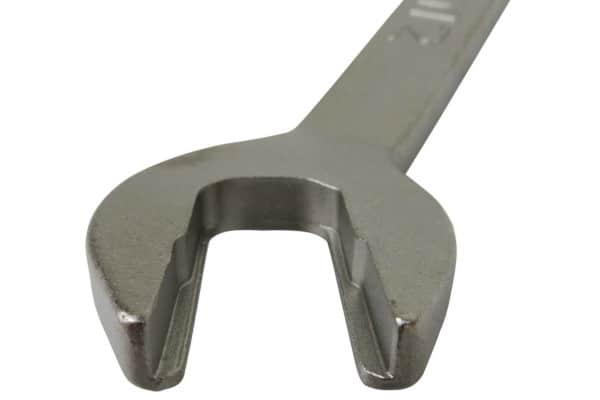
16.2.7.6* One sprinkler wrench as specified by the sprinkler manufacturer shall be provided in the cabinet for each type of sprinkler installed to be used for the removal and installation of sprinklers in the system.
NFPA-compliant cabinets include only wrenches specified by the manufacturer. If you have a variety of sprinklers in use—and those sprinklers require different wrenches—your fire sprinkler cabinet will require more than a single wrench. That said, multiple sprinklers from the same manufacturer may be compatible with one specific wrench.
To learn more, read our blog: “Which Fire Sprinkler Wrench Do I Need?“
Each cabinet must contain spare fire sprinkler heads with the right style, temperature rating, and other critical characteristics
NFPA 13 requires that spare sprinklers kept in a cabinet bear a close resemblance to the sprinklers currently installed.
From the 2025 edition of NFPA 13
16.2.7.2 The sprinklers shall correspond to the types, orientations, and temperature ratings of the sprinklers in the property.
NFPA further details the requirements for replacement sprinklers in NFPA 25: Standard for the Inspection, Testing, and Maintenance of Water-Based Fire Protection Systems.
From the 2026 edition of NFPA 25
5.4.1 Sprinklers.
5.4.1.3* Replacement sprinklers shall have the proper characteristics for the application intended, which include the following:
(1) Style
(2) Orifice size and K-factor
(3) Temperature rating
(4) Coating, if any
(5) Deflector type (e.g., upright, pendent, sidewall)
(6) Design requirementsA.5.4.1.3 To help in the replacement of like sprinklers, unique sprinkler identification numbers (SINs) are provided on all sprinklers manufactured after January 1, 2001. The SIN accounts for differences in K-factor, deflector characteristics, pressure rating, and thermal sensitivity.
Replacement sprinklers don’t need to match exactly. NFPA rules don’t, for instance, require the exact same sprinkler, including model and brand, and the activation temperature can be slightly different if it is still within the same temperature range found in Table 5.4.1.6.2. But locating an exact match is the easiest, compliant way to ensure the same performance characteristics for the sprinklers you have and the ones you need to purchase.
Fire sprinkler identification numbers can make completing your cabinet simple
Your sprinkler’s sprinkler identification number (SIN) can make this task considerably easier. The SIN is imprinted on sprinklers made since January 1, 2001 (and listed in a complete fire sprinkler cabinet, as we’ll describe next), and it identifies the manufacturer and model of a fire sprinkler. When combined with the activation temperature and finish of a sprinkler, a SIN points to an exact match.
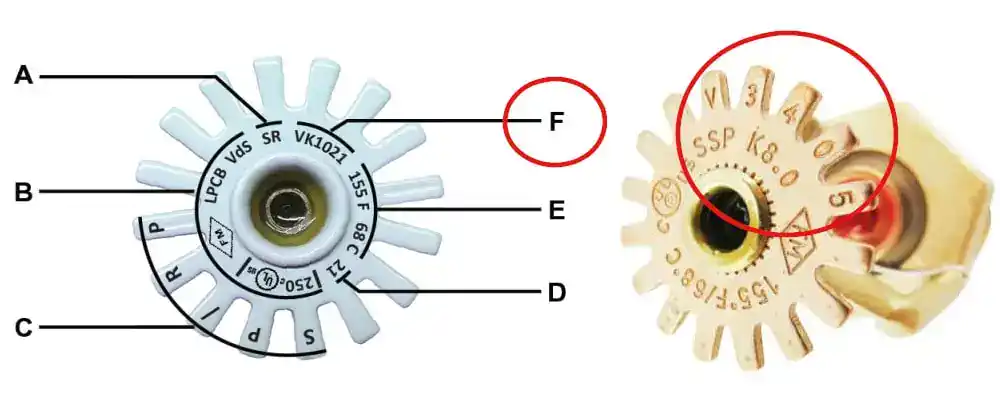
Check out our guide for more info on identifying your sprinklers’ characteristics and sprinkler identification numbers.
Complete fire sprinkler head cabinets contain a list of the sprinkler types currently installed
All fire sprinkler cabinets must contain a full list of the sprinkler types currently installed. The need for and nature of this list is specified in section 16.2.7.7.1* of NFPA 13 and the system maintenance requirements of NFPA 25:
From the 2023 Edition of NFPA 25
5.4.1.6.6 A list of the sprinklers installed in the property shall be posted in the sprinkler cabinet.
5.4.1.6.6.1* The list shall include the following:
(1) Sprinkler identification number (SIN), if equipped, the manufacturer, model, K-factor, deflector type, thermal sensitivity, pressure rating, and temperature rating
(2) Manufacturer’s sprinkler wrench model number for each sprinkler type
(3) General description
(4) Quantity of each type of sprinkler installed in the property
(5) Quantity of each type of sprinkler to be contained in the cabinet
(6) Issue or revision date of the listA.5.4.1.5.6.1 The minimum information in the list contained in the spare sprinkler cabinet should be marked with the sprinkler identification described in 5.4.1.6.6.1; a general description of the sprinkler, including upright, pendent, residential, ESFR, and so forth; the quantity of each type of sprinkler installed in the property; the quantity of sprinklers that is to be maintained in the spare sprinkler cabinet; and a sprinkler wrench type.
The NFPA 25 Annex also provides a helpful visual example of this list:
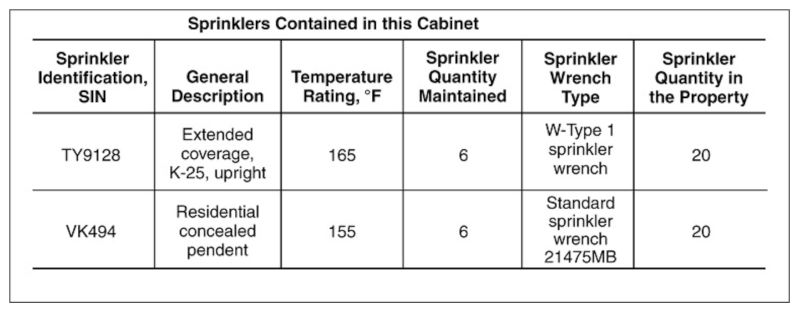
The list helps facilities managers or maintenance contractors select an appropriate replacement when a spare is used. It also expedites sprinkler system inspections required in NFPA 25 by allowing the inspector to confirm that the cabinet contains the appropriate number and types of spares.
Stocking and selecting your fire sprinkler cabinet
QRFS carries a wide selection of fire sprinkler heads designed to meet the needs of your NFPA-compliant system. We offer fire sprinkler heads and wrenches from Victaulic, Senju, Tyco, Viking, and Reliable. We also stock durable, 22-gauge steel sprinkler head cabinets to hold three, six, 12, 24, and 36 spare fire sprinklers.
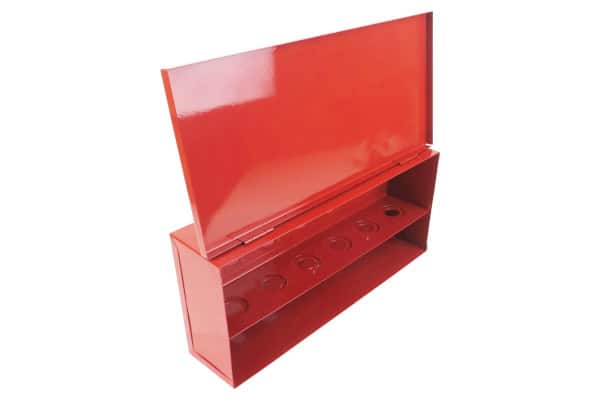
Our selection also includes large cabinets for storing early-suppression fast response (ESFR) fire sprinkler heads with extra large orifices (ELO).
Click here to browse our selection of fire sprinkler cabinets.
When you buy from QRFS, you benefit from our responsive and knowledgeable customer service. We strive to stay up to date on industry best practices and NFPA codes and standards, so we can provide you with the information you need, when you need it.
Questions about sprinkler cabinets? Having trouble choosing one? Call us at +1 (888) 361-6662 or email support@qrfs.com.
This blog was originally posted by Jason Hugo and Anna Hartenbach at blog.qrfs.com on August 17, 2017, and updated on January 11, 2023 and September 17, 2026.

Would you have or know where i can get a list like a blank one for the box? i got tagged for this and also wondered it is required to have. Thanks
Bart — A list is required to have by both NFPA 25 (maintenance standard) and NFPA 13 (installation standard), which are likely enforceable based on your local fire codes. We don’t know of a pre-made blank list, but making one yourself is simple. In the Annex, NFPA 25 provides a visual sample under FIGURE A.5.4.1.5.6.1 (And in NFPA 13: Figure A.6.2.9.7.1). It’s a simple table: the column headings are Sprinkler Identification Number, Sprinkler Temperature Rating, and Sprinkler Quantity Maintained (in the cabinet). The rows are the different types of sprinklers you need in the cabinet.
Question: In NFPA 25 there are two requirements for when a sprinkler head must be changed for standard response sprinkler heads. One says 50 years which is the rule I am familiar with however in the 2002 edition and newer in section 5.3.1.1.1.5 it also states 75 years for replacement. Which one do you usez?.
Joseph — First, you can read our complete guide to the latest fire sprinkler replacement & testing rules in the 2023 edition of NFPA. NFPA 25 makes a distinction between sprinklers over 50 years old and sprinklers over 75 years old & manufactured in 1920 and later in terms of the subsequent testing or replacement intervals: every 10 years once they hit 50, every 5 years once they hit 75. In either case, they must be tested or replaced at the relevant interval. Here are the references:
5.3.1.1.1 Where sprinklers have been installed for 50 years, one of the following shall occur:
(1) The sprinklers shall be replaced.
(2) Representative samples of the sprinklers shall be tested and then retested every 10 years.
5.3.1.1.1.4* Where sprinklers have been manufactured in 1920 and later and have been installed for 75 years, one of the following shall occur:
(1) The sprinklers shall be replaced.
(2) Representative samples of the sprinklers shall be tested and then retested every 5 years.
Should the list of sprinklers referenced in NFPA 25 5.4.1.5.6 be the spares in the cabinet or an inclusive list of everything on the installed in the system?
John — the spares themselves must reflect every type of sprinkler; if you use more than one kind of head (for instance, if you use both certain quick-response and standard sprinkler heads), you must have at least 2 of each kind. And you need to know the total number of sprinklers in the system to know how many spares you need. So, the best list would be a simple itemization like “100 of (these SINs), 50 of (these SINs), etc.”