


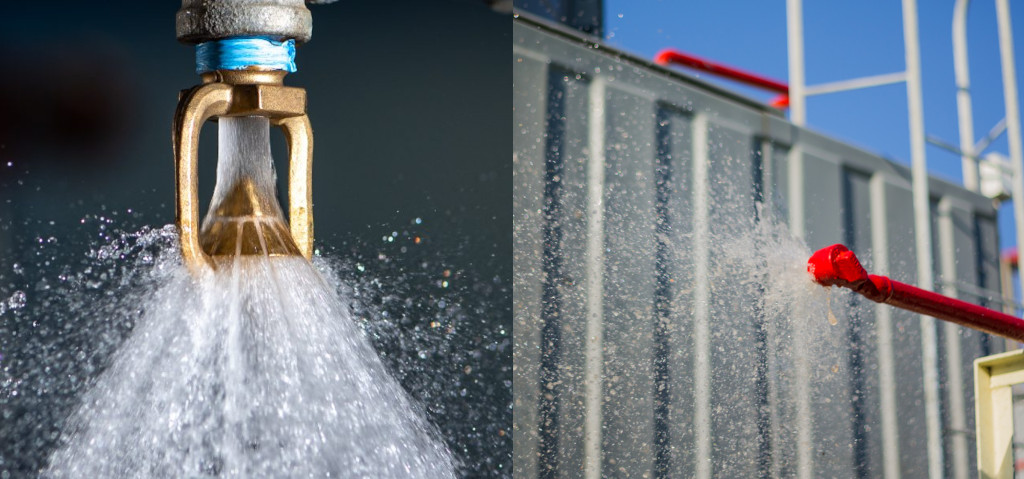
Understanding these vital parts used in NFPA 15, NFPA 750, and NFPA 13 systems
Though they can look very similar to fire sprinklers, water spray nozzles are not the same. Where sprinklers are more general-purpose fire-suppression and control hardware, nozzles protect special hazards and environments. And while nozzles can be employed in “classic” fire sprinkler systems, their main use is found in water spray systems and water mist systems.
In this blog, we break down these concepts:
- What nozzles are, and their common features
- Types of systems that use nozzles
- Some basic categories of spray nozzles, plus special-application hardware
Because nozzles are typically open rather than automatically activated by local ambient heat, it’s important to understand deluge systems—which most NFPA 15 water spray fixed systems are. Check out our linked articles on the subjects!
QRFS aims to be your nozzle resource. We have a wide variety of spray nozzles in stock. If you don’t see a specialty nozzle you need, contact our customer service team for help.
What is a water spray nozzle?
Nozzles are not fire sprinklers, though they both serve as the business ends of fire suppression systems. What’s the difference? As we’ll dive into later, water spray nozzles often protect a variety of unique, special-hazard environments and equipment. Thus, they come in many different shapes and sizes. Nevertheless, nozzles have some common distinguishing features. In general:
- Nozzles are often directional.
- Nozzles produce specific, targeted spray patterns.
- Nozzles are usually (but not always) open, lacking a plug held in place by a heat-sensitive element.
- Nozzles usually have small K-factors
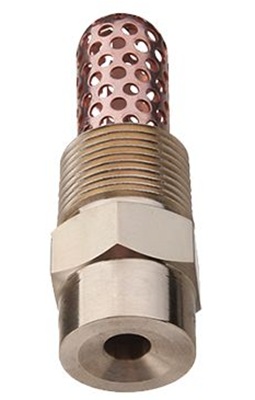
- Nozzles may have strainers and dust caps to prevent clogs.
Let’s take a closer look at each of these characteristics.
Water spray nozzles are often directional
Unlike fire sprinklers, most fire protection nozzles don’t, strictly speaking, have “orientations” like upright sprinklers, pendent sprinklers, or sidewall sprinklers. With exceptions, nozzles can generally be pointed in any direction: upright, sideways, pendent-style, or at whatever angle is needed. Water spray nozzles that can do this are sometimes called “directional.” This characteristic indicates that their purpose is often spray directed onto specific targets.
NFPA 15: Standard for Water Spray Fixed Systems for Fire Protection explicitly accounts for this deployment:
From the 2027 edition of NFPA 15
6.2.3 Water spray nozzles shall be permitted to be placed in any position, within their listing limitations, necessary to obtain proper coverage of the protected area.
“Within their listing limitations” is an important part of this quote, because some nozzles do have an orientation. For example, Tyco’s Type MV-T nozzle, designed specifically to protect the top of tanks, is installed only in the upright orientation and features a deflector extremely similar to that of an upright sprinkler.
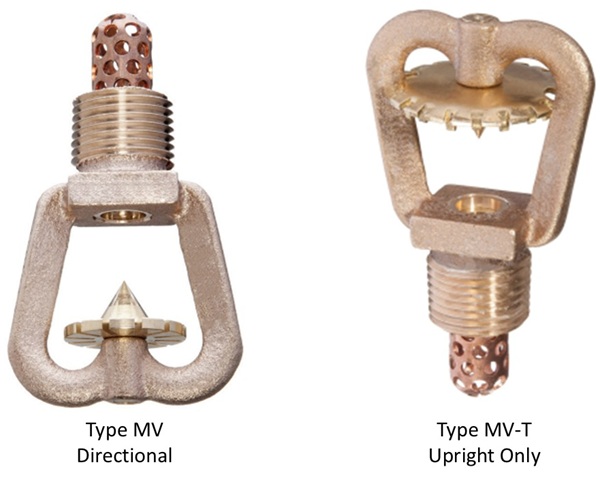
Nozzles spray water at specific angles
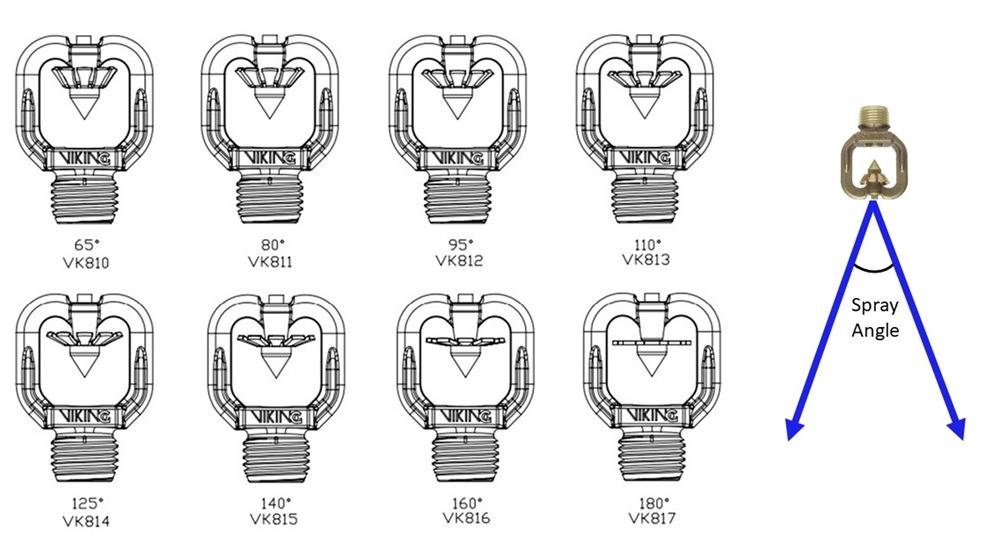
In line with their role of directional water delivery, water spray nozzles eject water at specific angles to achieve specific spray patterns. The spray angle is the angle made by the water jet as it exits the nozzle. This contrasts with the typical umbrella-shaped water pattern sprayed by fire sprinklers. The angle of the water spray is controlled by the shape of the nozzle, something that is easily seen in medium-velocity external-frame models, which we will discuss shortly. Nozzles sold with a low spray angle produce a tight, narrow jet, while those with angles closer to 180 degrees produce very wide sprays.
Most water spray nozzles are open-type for use in deluge systems
As mentioned earlier, most NFPA 15 systems are deluge systems. Thus, the typical nozzle is open and does not feature a heat-sensitive element that automatically breaks during a fire, thereby releasing a plug. Water flow is instead controlled by the system’s deluge valve opening to flood the system, which, in turn, is controlled by various detection devices that send electrical signals.
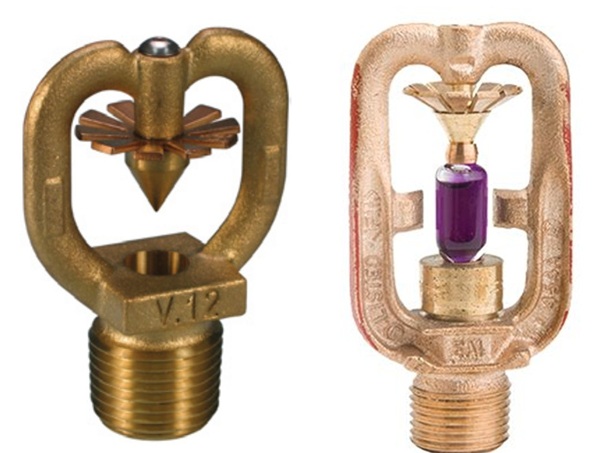
However, there are atypical situations, and NFPA 15 (A.3.3.23.2) says that while most are are open, “it is possible for nozzles to be equipped with operating elements such as fusible links or glass bulbs,” depending on the specific design needs. One application of automatic, heat-sensitive nozzles is for pilot lines (3.3.17). As we discussed in our article on deluge systems, pneumatic (air-filled) or hydraulic (water-filled) pilot lines capped by automatic sprinklers or nozzles can be used to actuate a deluge valve. This is very similar to how dry or preaction systems work. When nozzles are automatic, their heat-sensitive glass bulbs follow the same color scheme as fire sprinklers, which indicates their temperature rating.
Nozzles often have small orifices and low K-factors
Like fire sprinklers, spray nozzles usually have K-factors that describe the size of the orifice and how much water flows through them. The K-factor formula is:
q = K √p
Where:
q is the flow rate (GPM)
K is the K-factor
p is the water pressure (PSI)
In simple terms, the bigger the K-factor, the bigger the flow rate of water through the orifice. Orifice size is the key element that determines K-factor: bigger hole, bigger K-factor, bigger flow.
In general, water spray nozzles have smaller orifices and K-factors than traditional fire sprinklers. Where fire sprinkler K-factors range from 1.4 to 33.6, and the most common sprinkler K-factor is 5.6, a Tyco Model HV high-velocity nozzle has K-factors ranging only from 1.6 to 6.4. The purpose of the smaller orifices is to generate higher-velocity water droplets. The velocity of the droplets is a distinct concept from the rate of water flow; this is the same principle you experience when you put your thumb over the end of a garden hose to make it spray farther.
Spray nozzles are sometimes divided into “low,” “medium,” and “high” velocity categories, whose applications we’ll discuss in the next section. As Viking discusses in this technical bulletin, low-velocity models have larger K-factors and orifice sizes that are more in line with traditional sprinklers than with other nozzles.
We said that nozzles usually have small orifices and K-factors. But for some special applications, nozzles can have exceptionally large K-factors. For example, Tyco’s TN-25 nozzle has a K-factor of 25.2.
Nozzles often have integral strainers and dust caps to prevent clogs
Because nozzles usually tend to have smaller K-factors and orifices, they can be more prone to clogging with debris that would simply pass through a fire sprinkler. Thus, they may need strainers and dust caps to prevent clogs that would affect performance. NFPA 15 specifies requirements for strainers in pipes supplying spray nozzles; individual or integral strainers are also required for any models with waterways smaller than 3⁄16 in. (5 mm) (6.4.6.3). Nozzles may also be equipped with dust caps that protect the orifice from debris. These caps are designed to blow off when water flow starts.
Types of systems that use water spray nozzles
Nozzles can be employed in several different systems, including:
- Fire sprinkler systems complying with NFPA 13: Standard for the Installation of Sprinkler Systems (2025 edition)
- Fixed spray systems, complying with NFPA 15: Standard for Water Spray Fixed Systems for Fire Protection (2027 edition)
- Water mist systems, complying with NFPA 750: Standard on Water Mist Fire Protection Systems (2023 edition)
NFPA 13 systems sometimes use them
NFPA 13 systems are ‘regular’ sprinkler systems that use automatic fire sprinklers. But sometimes, spaces protected by NFPA 13 systems present special hazards that may require a nozzle rather than a fire sprinkler.
For example, NFPA 13 requires some ductwork to be sprinklered internally (8.9.3.4), and the standard is agnostic on which kind of hardware to use (sprinkler or nozzle). However, given that this application requires low K-factors (8.9.6.3) and that some nozzles are specifically designed for ductwork protection, they can make sense.
NFPA 13 systems may also protect a building with deep-fat fryers. If you know anything about grease fires, you know that water is typically a bad way to try to put them out. So, if water-based systems are to be used over these areas, NFPA 13 requires specially designed and listed sprinklers or nozzles (8.9.8.2.1) that can produce a small-droplet spray capable of smothering a fire rather than just splashing burning grease.
NFPA 15 fixed spray systems
NFPA 15 fixed spray systems are typically deluge systems that use nozzles as the default hardware to provide directional spray on a variety of special hazards that wouldn’t be well served by an NFPA 13 system. For example, large electrical transformers, coal shoots and conveyor belts, and large fuel tanks may be protected by NFPA 15 systems with one or more of four possible goals (4.1):
- Fire extinguishment by cooling, smothering, emulsification, dilution, or some combination of these
- Control and containment of fire
- Exposure protection, meaning preventing fire or heat from spreading to an object or location
- Prevention of fire by preventing heat buildup, ignition, or explosion
The design of water supplies, deluge valves, actuating devices, and nozzles is a complicated endeavor. While NFPA 13 provides detailed instructions for laying out a sprinkler system, NFPA 15 leaves much to the expertise of design engineers. NFPA 15 says (A.4.3): “Water spray system installation is a specialized field that is a trade in itself.” Check out our previous blog for a complete breakdown of NFPA 15 systems and how they accomplish their design objectives.
Water mist systems
Water mist systems, like NFPA 15 fixed spray systems, rely on nozzles to spray water or a mixture of water and other agents in a mist for fire control, suppression, or extinguishment. These systems have applications in a wide variety of settings, from heavy industrial and chemical facilities to computing and residential settings.
Types of water spray nozzles
Because nozzles perform such a wide variety of roles, there are many different kinds of nozzles. Let’s take a look at:
- Medium-velocity nozzles
- High-velocity nozzles
- Window nozzles
- Specialized nozzles
Medium-velocity nozzles provide exposure control and fire prevention
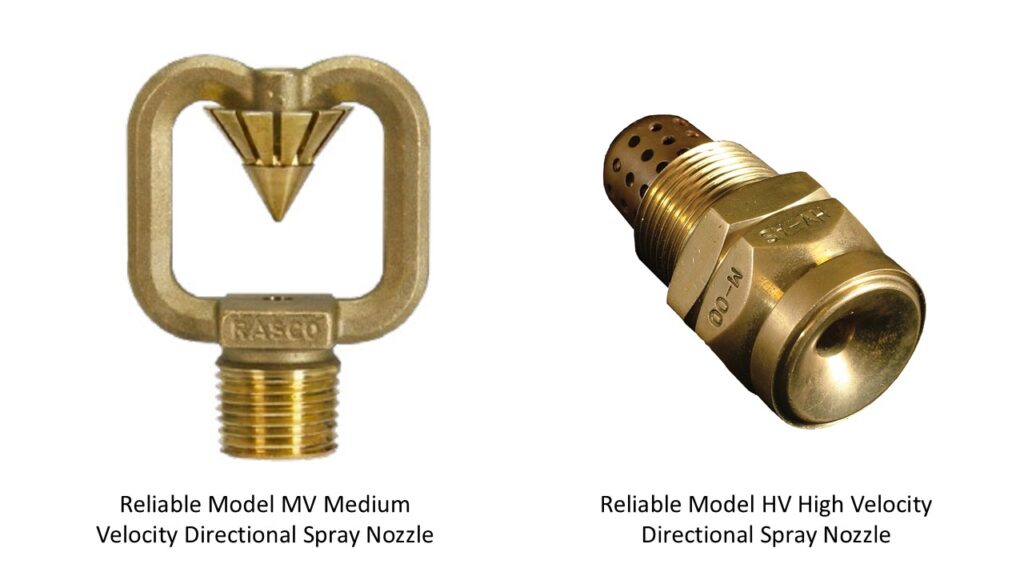
Some nozzle types are named for the speed of the water spray they produce. Medium-velocity nozzles expel water droplets at a comparatively mid-point rate of spray: faster, higher-momentum droplets than standard sprinklers, but not the fastest. Medium-velocity nozzles almost always resemble standard fire sprinklers at least superficially, with an external frame holding a deflector that shapes the water. As Tyco and Reliable explain, this hardware is typically used to apply water to exposed surfaces to prevent fire spread and the transfer of heat from an external fire (exposure control). They can also be used for control or extinguishment.
High-velocity nozzles provide control and extinguishment
High-velocity nozzles don’t look like fire sprinklers at all, with only the external orifice exposed. Inside, these nozzles have a swirl plate that forces water to flow in a vortex pattern before being discharged. The result is a tight, high-velocity water cone that ‘attacks’ a blaze to suppress or extinguish it.
Window nozzles turn large glass windows into rated exposures
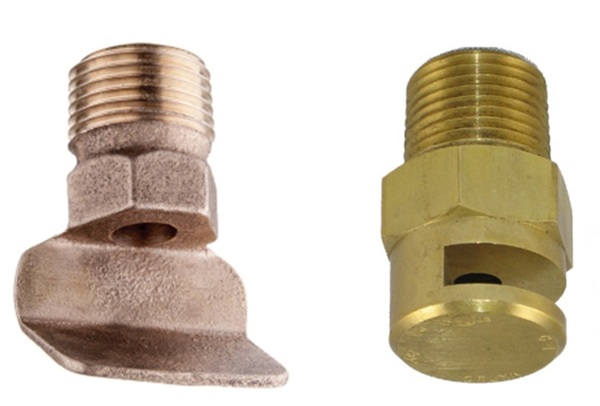
Unless they are specially treated (at great expense), large glass windows and walls are prone to shattering during fires, which makes them unsuitable for rated enclosures. In life safety and building codes, rated enclosures are areas designed to resist fire for a certain amount of time to “compartment” sections of the structure and buy time for escape, rescue, and firefighting operations. Glass is not usually suitable for rated enclosures, but window sprinklers or window nozzles coat glass windows and walls in a cooling curtain of water—floor to ceiling, end to end—so they don’t shatter in a fire. Check out our previous blog on window sprinklers for more details.
Water mist nozzles
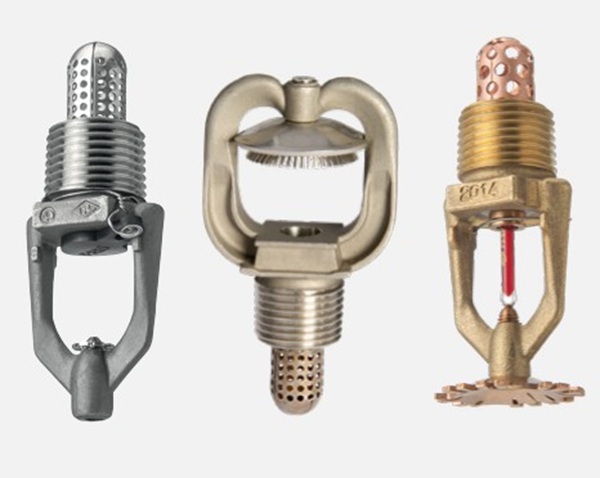
Misting nozzles are designed to produce an extremely fine spray of water or another agent. Rather than selling mist nozzles a la carte for installation, some manufacturers provide entire pre-engineered mist systems, such as Tyco’s Aquamist brand.
Specialty nozzles
Beyond window nozzles, many sprinkler manufacturers produce specialty nozzles for highly specific situations. Some of these include:
- Tyco’s cooling tower nozzles
- Tyco’s DN-5 duct nozzles
- Viking’s low-pressure nozzle for particleboard presses
- Various foam-water and foam-specific nozzles
Hardware that protects special occupancies and hazards
Water spray nozzles are special tools in the toolbox of fire protection system designers. For situations not adequately served by an NFPA 13 sprinkler system, an NFPA 15 directional spray system can provide fire extinguishment or control, mitigate damage, and prevent heat buildup and ignition. Protecting chemical tanks, coal conveyor belts, diesel engines, ducts, and high-voltage oil-immersed electrical equipment are just some examples of situations that might require nozzles.
If you need this equipment, QRFS has a wide variety of spray nozzles in stock. If you don’t see a specialty nozzle you need, contact our customer service team for help.
This blog was originally posted at blog.qrfs.com.
Top image sources: Reliable, Shutterstock.
