


Understanding the business end of NFPA 13 deluge sprinkler systems
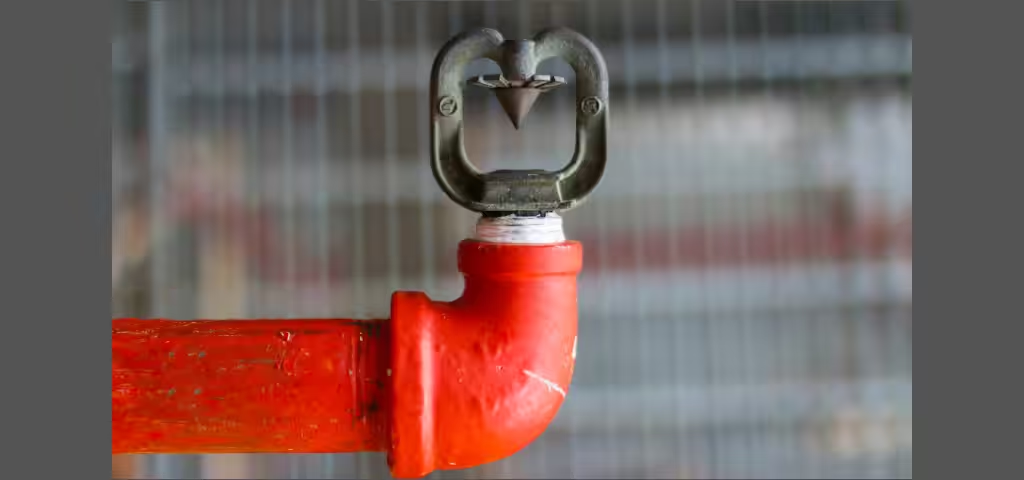
Open fire sprinklers share most of the same features as normal sprinklers—frames, deflectors for shaping water spray, and threads for installation—but they lack automatically activated thermal elements and plugs. Soldered links or liquid-filled glass bulbs normally control the flow of water from automatic sprinklers, only releasing a plug and the water behind it when temperatures get high enough to melt the links or rupture the glass bulbs.
In contrast, open sprinklers have a waterway that is, well, always open, without a bulb, link or plug in sight.
In this article, we’ll explain:
- What an open sprinkler is
- The difference between an open sprinkler and a nozzle
- How open sprinklers are used in deluge systems
QRFS has a massive range of fire sprinklers from Tyco, Reliable, Viking, and Victaulic. Many of these are available as open sprinklers. Reach out to our customer service team to inquire and place an order for an open version!
What is an open sprinkler?
Again, an open sprinkler is essentially the same as an automatic sprinkler, but without the heat-sensitive element and sealing assembly—simple as that.
Because the waterway remains open, the sprinkler itself is not automatic. Water flow must be controlled by an automatically or manually triggered deluge valve positioned between the water supply and most of the sprinkler system’s pipe network—more on the applications of this setup in the next section.
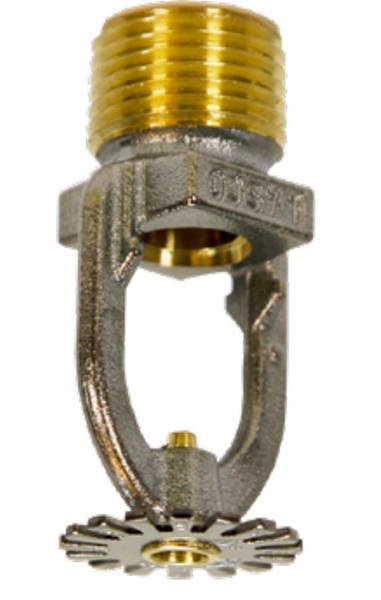
Because open sprinklers are just like any other sprinkler except for being open, companies like Reliable, Viking, and Tyco offer many of their sprinkler heads in either a traditional or open format. This spec is often requested as a “temperature” option on specific models, which will be reflected on the manufacturer’s data sheet.
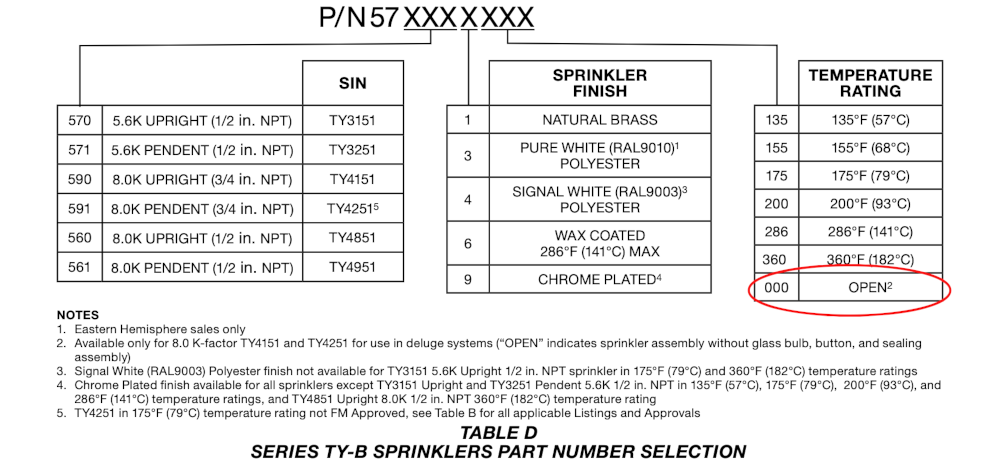
Thus, the main considerations when selecting open sprinklers mirror the selection criteria for regular sprinklers, minus a temperature rating: the orientation (upright, sidewall, pendent), the coverage type (standard or extended), the K-factor, and any other relevant performance characteristics or finishes. You’ll need to choose a sprinkler that meets your system’s specific design and installation needs, including providing adequate coverage of the protected area and sufficient water flow.
Open sprinklers are not nozzles
Although nozzles and open sprinklers may seem similar, they are fundamentally different types of hardware. Yes, both types of devices can shape water spray patterns with a deflector, nozzles are usually (but not always) open rather than automatic, and nozzles are also present in systems with a deluge valve (more on that soon). But the similarities end there.
Nozzles are highly specialized hardware that typically:
- Are available with different listed spray angles and discharge patterns
- May be installed at various angles or orientations, according to their listing and manufacturer instructions
- Are arranged to direct water onto a particular surface, object, vessel, or hazard
These nozzle features allow system designers to target specific objects or areas with directional water spray. Unlike open sprinklers, nozzles are typically used in water spray systems designed according to NFPA 15: Standard for Water Spray Fixed Systems for Fire Protection (2027 edition). They can also be used for water mist systems as described in NFPA 750: Standard on Water Mist Fire Protection Systems (2027 edition). For more information, check out our previous blogs:
Open sprinklers, on the other hand, are generally designed to distribute water over an area rather than direct it at a particular object or surface. They have specified upright, pendent, or sidewall orientations and corresponding spray patterns shaped by their deflectors. In addition, open sprinklers are used in specific deluge sprinkler systems designed according to NFPA 13: Standard for the Installation of Sprinkler Systems.
For more clarity on the difference between the two, know that in the US, open sprinklers are commonly tested and listed under UL 199, while fixed water-spray nozzles are commonly listed under UL 2351. Water-mist nozzles are evaluated under separate standards.
Deluge sprinkler systems use open sprinklers
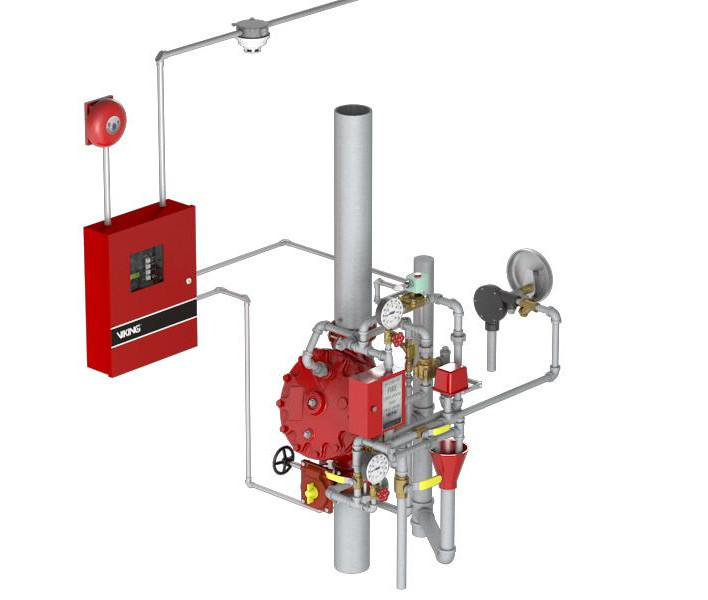
Open fire sprinklers are the business end of NFPA 13 deluge sprinkler systems. Since they lack the heat-sensing bulb or link found in automatic sprinklers, water flow is controlled by a deluge valve that releases a deluge of water to the pipe network, which then flows out of all open sprinklers at once.
In an electrically released system, this deluge valve is triggered by actuating devices, such as smoke detectors, heat detectors, or manual release stations, that send an electrical signal to a control panel, which energizes a solenoid or other releasing device on the valve trim, causing the deluge valve to open. This process contrasts with traditional automatic sprinklers in wet systems, where water only flows through specific heads that activate due to nearby heat.
Deluge systems are, per NFPA 13 (2025: 15.1.1), used to protect “special hazards or exposures or in other special locations.” You can read more about deluge systems in our previous article on the subject.
Examples of occupancies and processes for which the applicable NFPA standard may require or permit a deluge system include:
- Flammable propellant charging and pump rooms (NFPA 30B)
- Places where flammable or combustible materials are applied by spray (NFPA 33: 9.5.1.1)
- Solvent extraction (NFPA 36: 4.9.1)
- Mobile acetylene trailer system (NFPA 51: 10.5.8.1.1)
- Some aircraft hangars (NFPA 409: 7.4.1.2)
- Aircraft engine test facilities (NFPA 423: 7.6)
- Hyperbaric facilities (NFPA 99)
Earlier editions of NFPA 13 included additional provisions and references concerning certain special-hazard applications. However, in the 2025 edition, Section 15.1.1 directs users to the applicable occupancy- or hazard-specific standards, which determine when deluge protection is required and may establish specialized design criteria. Nevertheless, NFPA 13 continues to govern the general design and installation of these systems.
This NFPA 13 design philosophy is all about the density of the water covering an area. As we’ve discussed in our articles on sprinkler system design, many NFPA 13 systems are hydraulically designed using a required discharge density over a specified design area based on the occupancy, hazard, storage arrangement, sprinkler type, and any other requirements from a hazard-specific standard.
This density is applied over a specified design area, generally representing the most hydraulically demanding portion of the system where it’s most challenging to deliver water. Knowing the required density and design area allow the designer to determine the necessary water flow and pressure.
NFPA 13-style deluge systems use this same basic concept, but with a significant difference: Because every open sprinkler supplied by an operated deluge valve discharges when that valve opens, the hydraulic calculation generally includes all sprinklers within that deluge system or operating zone—not just a design area.
Open fire sprinklers are an important fire protection tool
Deluge systems are needed in some hazardous environments where an entire area may need to be doused with water all at once. To achieve this flood, open sprinklers that allow comprehensive, simultaneous water flow are necessary.
However, like with regular sprinklers, choosing open versions relies on ensuring the key performance characteristics and specs, such as K-factor and deflector type, match exactly what the system’s design calls for.
QRFS stocks a wide selection of fire sprinklers and spray nozzles from all five major manufacturers. If you need a specific sprinkler in the open format, contact our customer service team!
This blog was originally posted at blog.qrfs.com.
