


New sprinkler inspection, testing, and maintenance requirements in NFPA 25’s latest edition
Inspection, testing, and maintenance (ITM) are essential for ensuring the consistent operation of fire sprinklers and other water-based fire protection systems. The National Fire Protection Association recently released the 2026 edition of NFPA 25: Standard for the Inspection, Testing, and Maintenance of Water-Based Fire Protection Systems, which is adopted as law in many jurisdictions across the United States and internationally.
The new NFPA 25 2026 contains many helpful clarifications and additional rules designed to ensure the safety and reliability of systems, and we’re looking at some of the major changes, including:
- The meaning of who is “qualified” to work on systems
- Impairment procedures and conditions
- ITM for fire sprinklers and assemblies
- ITM for sprinkler system hardware and components
Need system parts? Let QRFS be your partner for fire sprinklers, cover plates, escutcheons, wrenches, and other fire protection equipment.
Updated qualification rules in NFPA 25 2026
NFPA 25 and other standards have long specified that people who work on fire protection systems must be “qualified personnel.” In the 2023 edition (and previous editions), section 4.1.1.3.1 provided a detailed list of how someone might become “qualified,” but this section has been entirely removed in the 2026 edition. Instead, section 4.1.1.3 now says this, with the addition emphasized in italics:
4.1.1.3 Inspection, testing, and maintenance shall be performed by qualified personnel for the specific tasks performed in accordance with this standard.
The operative language, “qualified…for the specific tasks performed,” is a small but commonsense change, because it recognizes that different ITM tasks require different levels of qualification. Performing a flow test or maintaining a fire pump requires a much higher level of skill and experience than visually checking a valve’s open or closed status or inspecting a pipe for leaks.
In addition, by making the “qualified” standard less specific, NFPA 25 allows Authorities Having Jurisdiction (AHJs) to define licensing and other standards for different tasks while still emphasizing that qualification is essential.
Impairments and impairment procedures in NFPA 25 2026
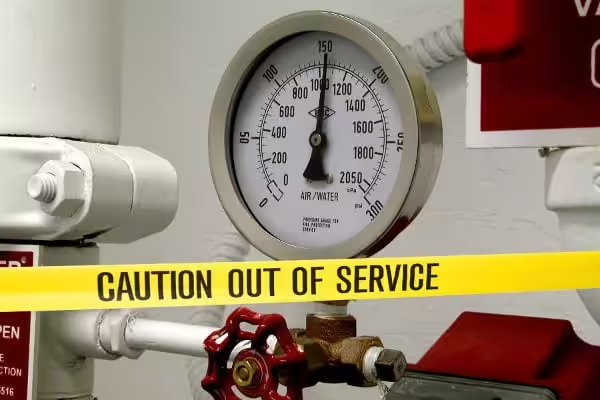
Some of the major changes to NFPA 25 concern the handling of impairments. An impairment, per paragraph 3.3.22, is a situation where a fire protection system—or a unit or portion of it—is “out of order” in a way that can result in failure to function. There are two kinds of impairments: planned impairments occur during expected ITM procedures, while emergency impairments are unexpected.
The 2026 edition of NFPA 25 adds three major changes regarding impairments:
- Procedures for handling impairments
- Ice in the system as an impairment
- Corrosion mitigation technologies and impairments
Impairment handling procedures
A key step in handling impairments is notification procedures. Property owners should communicate with their AHJ, the fire department, and the alarm service, as applicable, while their fire protection systems are out of commission. The notification should include the purpose of the shutdown or test, which part of the system is affected, and the time and expected duration of the shutdown (4.1.4.2).
In the 2026 edition, NFPA 25 adds two major changes:
- Language (4.1.4.1) that clarifies that both preplanned and emergency impairments require notification procedures.
- Another clarification (4.1.6.2) states that impairments (as well as deficiencies) should be corrected on a timeline approved by the AHJ.
During the period in which the impairment has not been corrected, property owners must follow the impairment procedures in Chapter 15.
Ice in the system is defined as an impairment
One new addition to NFPA 25 2026 is an explicit statement that ice in the system constitutes an impairment. Freeze prevention is a major topic in fire protection, as ice can both plug the system (creating an obstruction to water flow) and rupture pipes. But until now, having ice in the system has not been clearly named as a system impairment. The new sections read thus:
4.1.2.6 Systems Containing Ice.
4.1.2.6.1 When the piping between the water supply and any discharge devices or hose connections of a water-based fire protection system is found to contain ice, the system shall be considered impaired.
4.1.2.6.2 System components found to contain ice shall be completely thawed out or replaced and the system restored to service.
Because ice can be so damaging to pipe networks, the process of thawing frozen system parts is very involved. As described in A.4.1.2.6.2, all components should be completely thawed and inspected for cracked or broken pipes, valves, fittings, and sprinklers. The annex also indicates that the system or section should be tested for invisible damage using a 2-hour, 40-PSI pressurized-air test. Similar to a hydrostatic test, a loss of pressure during the air test can identify leaks. This happens before a hydrostatic test is performed to return the system to service.
The changes do not explicitly state that the system or a section of it must be drained before this process can begin, but it is obviously necessary to complete the air test.
Expanded ITM of corrosion mitigation technology
Dry and preaction systems are highly susceptible to corrosion of the pipes from the inside out. Mixing residual moisture and air in a pipe drives oxidation that can create damage and leaks. But corrosion in the pipe is also highly consequential for hydraulics; as we’ve written on our blog previously, sprinkler system design accounts for the roughness of the pipe fighting against water pressure, and corrosion makes the pipe rougher.
Given this issue, NFPA 13 assigns a hydraulic penalty to dry and preaction systems in the form of a lower C-value, which measures pipe roughness. The higher the C-value, the smoother the pipe. Hydraulic penalties from lower C-values can necessitate using bigger pipes or a fire pump (or a larger pump than would otherwise be needed). Dry and preaction systems with black steel or galvanized steel pipe must use a C-value of 100 unless they use corrosion-prevention technology. If these anti-corrosion approaches are present, the system designers can use the standard C-value of 120.
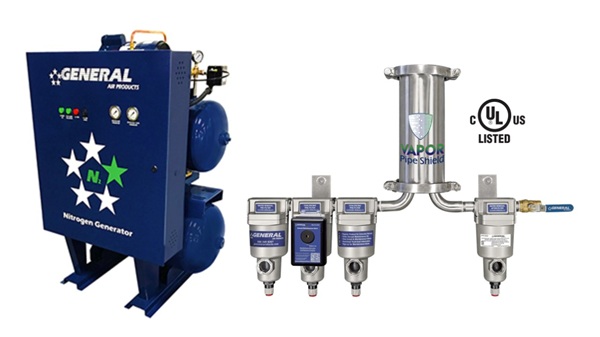
NFPA 13 allows and encourages the use of different corrosion-prevention technologies. Nitrogen systems, where pressurized air is replaced with nitrogen, are the old-school method, while vapor corrosion inhibitors and negative-pressure systems are more modern techniques. You can read a comparison of vapor corrosion inhibitor systems and nitrogen systems here.
The 2026 edition of NFPA 25 adds four key ideas that account for both new and existing anti-corrosion technologies:
- If nitrogen generators, vapor corrosion inhibitors, negative-pressure systems, or other approved technologies are used to achieve a C-value of 120, they must be inspected, tested, and maintained in accordance with the manufacturer’s instructions (4.1.5.1). This is a common-sense addition that is also present in NFPA 13.
- If the corrosion mitigation system is found to be deficient or impaired, it must be repaired or replaced (4.1.5.3)because the system’s hydraulic design assumes the absence of corrosion in the pipes.
- Failure to maintain a nitrogen supply except as part of a preplanned impairment indicates the need for an obstruction investigation (14.3.1(16)).
- If a non-functional corrosion-mitigation system is not repaired or replaced, the design of the entire sprinkler system must be recalculated to determine whether it remains within specifications with a lower C-value (4.1.5.2)
One thing that remains unclear is the timeline. The NFPA 25 committee did not clarify how long a corrosion mitigation system can remain nonfunctional before it begins to affect sprinkler system performance. For example, corrosion does not form in a dry system instantly when the nitrogen generation system fails, so it’s doubtful that a broken nitrogen generator, say, causes an emergency impairment or an obstruction the day it breaks.
ITM changes for sprinklers and sprinkler assemblies in NFPA 25 2026
The 2026 edition of NFPA 25 adds several requirements specifically related to sprinkler ITM, including:
- The rules for escutcheons and cover plates in listed sprinkler assemblies
- Testing and replacement rules for dwelling-unit sprinklers
- Expansion of the list in spare sprinkler cabinets
New replacement rules for escutcheons and cover plates in listed sprinkler assemblies
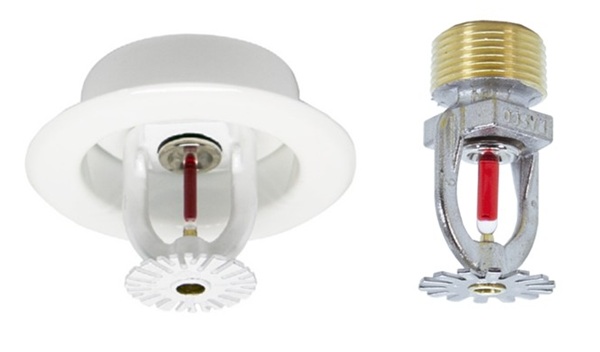
The new edition includes several additions and revisions to listed sprinkler assemblies. A “listed assembly” is a combination of the sprinkler head itself, an escutcheon, and sometimes a cover plate. The concept is important because some ways of installing sprinklers—namely recessed, flush, and concealed—require specifically tested components to comply with the manufacturer’s listing. For these types of installations, you can’t just use any escutcheon or cover plate—it must match the specific sprinkler. You can read more about listed assemblies here.
In the older 2023 edition of NFPA 25, section 5.2.1.1.5 simply read:
5.2.1.1.5 Escutcheons and coverplates for recessed, flush, and concealed sprinklers shall be replaced with their listed escutcheon or coverplate if found missing during the inspection.
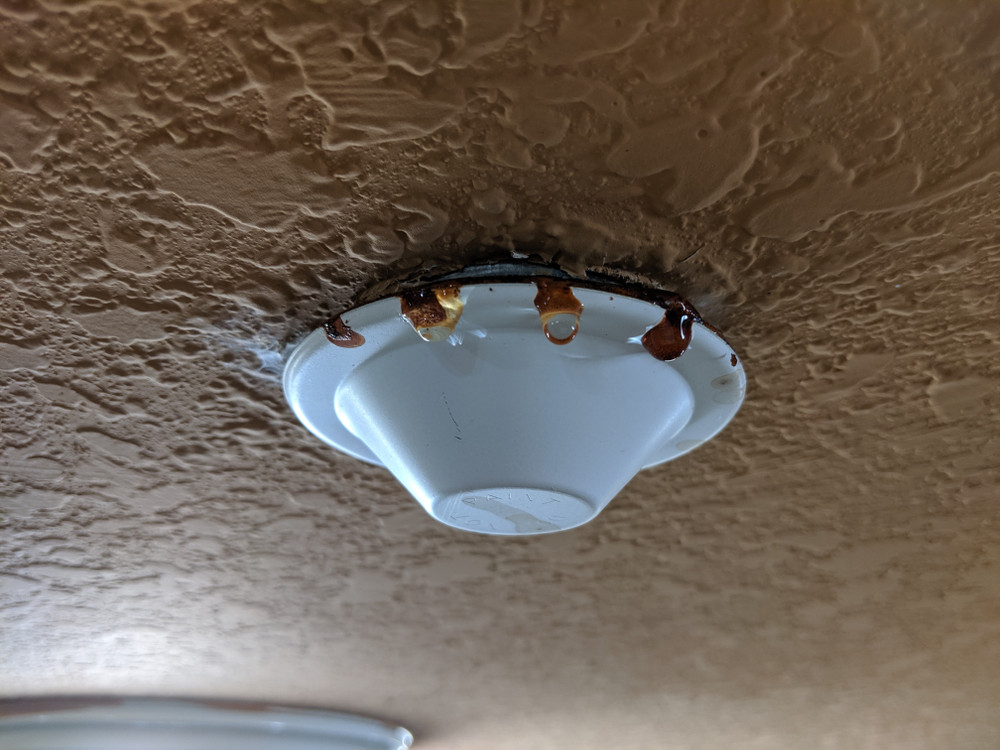
Now, the 2026 edition adds more failure conditions, largely mirroring the inspection criteria for fire sprinklers themselves. Escutcheons and cover plates for recessed, flush, and concealed sprinklers should be replaced with components that are part of the listed assembly if any of the following conditions are found (5.2.1.1.5):
- Physical damage
- Corrosion detrimental to sprinkler performance
- Loading detrimental to sprinkler performance
- Paint, other than that applied by the sprinkler manufacturer, detrimental to sprinkler performance
The 2026 edition also adds this section:
5.2.1.1.5.1 Where escutcheons and coverplates for recessed, flush, and concealed sprinklers are found to be adhered or attached to the ceiling or wall, they shall be replaced.
Replacing old sprinklers in dwelling units with fast-response sprinklers
NFPA 25 has long required that sprinklers with a long service life (the exact timeline depends on the sprinkler type and sometimes the environment) be tested or replaced. The test process is destructive to the sprinklers: a representative sample of heads is removed from the pipes and sent to a laboratory, where it is plunged into a hot oven. If the sample sprinklers activate quickly enough, they pass, and the remaining sprinklers can remain in place. If they fail to activate or don’t activate quickly enough, the remaining sprinklers must also be replaced. You can read more about this test process here.
A new section in NFPA 25 2026 focuses on sprinklers that are installed in dwelling units, which typically use residential sprinklers. In addition to having unique spray characteristics, residential sprinklers use fast-response elements that respond more quickly to heat than standard response sprinklers. The new section helps account for the fact that older sprinklers installed in residential settings were not all fast-response models:
5.3.1.1.1.7 Where sprinklers have been installed for 50 years in dwelling units, one of the following shall occur:
(1) The sprinklers shall be replaced with fast-response sprinklers.
(2) Representative samples of the sprinklers shall be tested for thermal sensitivity such that the RTI does not exceed 65 (meters-seconds)1⁄2.
RTI stands for response time index, a measure of how quickly a sprinkler’s thermal element responds to heat. New fast-response sprinklers have RTI values of 50 or less, but the new language gives 15 (meters-seconds)1⁄2 leeway for legacy sprinklers. If the sample sprinklers don’t meet that standard, all the remaining sprinklers should be replaced with modern fast-response sprinklers.
Spare sprinkler list updates
In our previous blog on lists of spare sprinklers for your spare sprinkler cabinet, we made a few suggestions for useful items to include that weren’t required by NFPA 25. The latest edition of the standard added some of this information in the most recent update.
The list, specified in section 5.4.1.6.6.1, should now include (bolded words indicate new language):
(1) Sprinkler identification number (SIN), if equipped, the manufacturer, model, K-factor, deflector type, thermal sensitivity, pressure rating, and temperature rating
(2) Manufacturer’s sprinkler wrench model number for each sprinkler type
(3) General description
(4) Quantity of each type of sprinkler installed in the property
(5) Quantity of each type of sprinkler to be contained in the cabinet
(6) Issue or revision date of the list
Notably, the list of sprinklers installed on the property, a key and very useful new change, has been required by NFPA 13 since 2007.
New and modified ITM for sprinkler system hardware and components
Pressure-reducing valve testing and maintenance changes
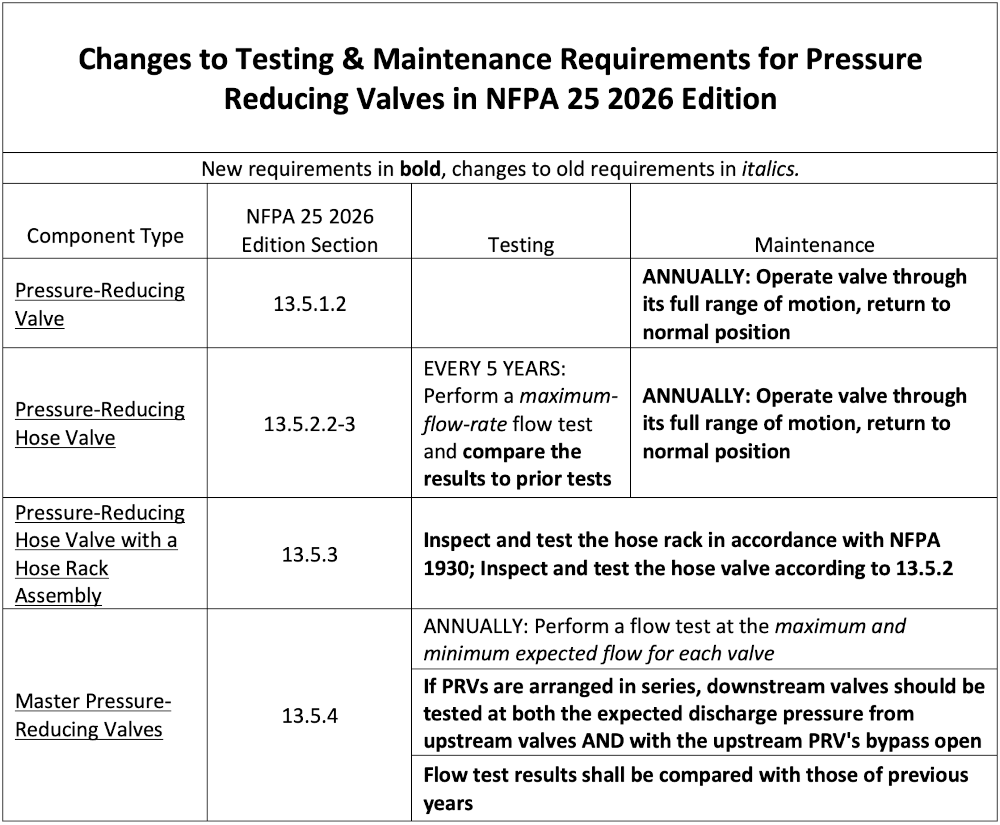
The new edition of NFPA 25 introduces several new requirements for the testing and maintenance of pressure-reducing valves (PRVs) and related hardware such as PRV hose valves and PRV hose valves with hose racks. These changes revolve around flow tests and the operation of valves through their full range of motion. The changes themselves are rather granular, so we’ve summarized them in the table below:
Testing options for waterflow alarm devices on dry and preaction systems
Sprinkler systems should be equipped with waterflow alarm devices, and this equipment needs regular testing. You can read more about these devices and their testing and maintenance here.
Water flow alarm testing should happen twice a year (semiannually), and the main method to do it is to flow water. Yet in dry and preaction systems, opening the inspector’s test connection can cause the system to trip accidentally.
Thus, the 2023 edition of NFPA 25 says the test should be conducted via the bypass. However, the 2026 edition (13.2.3.6) now names three options:
- The bypass connection
- The inspector’s test connection
- Automated testing
Keep in mind that if automated testing does not normally flow water, a water-flow test needs to be performed every 3 years (4.7.4.2).
A fire department connection pipe hydrostatic test exemption
NFPA 25 also includes a new section that allows property owners to forgo the standard five-year hydrostatic test of the pipe between the fire department connection (FDC) and the FDC check valve. This pipe can be subject to extreme pressures from a fire engine’s pump, so the test is necessary to ensure its integrity. However, this section of pipe is often quite short and easy to inspect.
So, the 2026 edition of NFPA 25 lets system owners avoid a hydrostatic test if the pipe is 10 feet or less in length and can be inspected visually internally and externally (13.8.5.2). The Annex suggests that the internal inspection can be accomplished by a camera. You can read more about FDC ITM requirements in our previous article.
How to handle hardware and pipe in inactive and abandoned systems
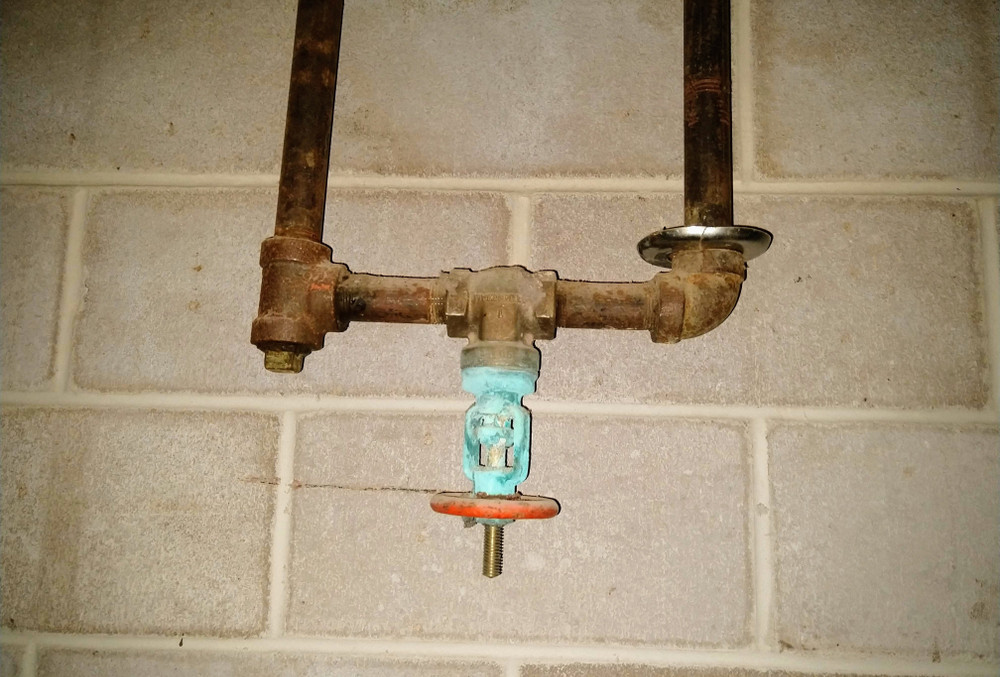
Sometimes, a defunct sprinkler or standpipe system is left in place rather than removed. Now, NFPA 25 includes a section dedicated to handling abandoned systems so they are not mistaken for functional systems. The aim is to both avoid wasted effort in ITM on abandoned systems and to ensure that their presence does not provide a false sense of security.
Section 4.1.13 says that:
- Sprinklers, hose valves, hoses, and alarm devices should be removed.
- Control valves should have their operating elements removed.
- Pipes and valves should be marked or otherwise uniquely identified to differentiate them from active pipes and valves.
Although new to NFPA 25, these rules have already existed verbatim in NFPA 13 for several editions.
Inspection, testing, and maintenance are essential in fire protection
NFPA 25 remains the industry standard for ITM, and the 2026 update introduced several important updates. Some of these are purely procedural, while others clarify impairments and set new rules for hardware ITM. In this article, we’ve hit what we consider some important updates, though we haven’t covered everything. Regardless, each new edition of the standard improves system ITM, helping ensure that water-based fire protection systems remain functional and ready to fight fires.
Check out our catalog for the sprinkler heads, wrenches, cover plates, escutcheons, valves, and other supplies and equipment you need to keep your fire protection systems compliant and ready to handle fires.
If you have questions or otherwise need help finding a fire protection part, contact us!
This blog was originally posted at blog.qrfs.com.
